Biblical studies
What does the text say?
- 16Fields
- 2,069Sources
- 190Key works
- 158Key terms
Reading order
Where to begin in this branch
Start with the fields the others build on.
 Step 1: Biblical and ancient languagesScripture was written in Hebrew, Aramaic and Greek, so every reading starts from what the text says in its own languages.
 Step 2: Textual criticismBefore anyone can say what the text says, the original wording must be known. Textual criticism weighs the manuscripts and the variants, and answers the question "has the Bible changed?"
 Step 3: Canon formation and canonicityTraditions hold different canons, from the Protestant sixty-six books to the Ethiopian Orthodox canon with 1 Enoch. This field shows which books count for whom, and why.
 Step 4: Bible translation and versionsMost people read a translation. Knowing how versions are made, from the Septuagint to modern English, explains why two Bibles read differently.
 Step 5: New TestamentThe Gospels, Acts, the letters and Revelation, with the scholarship on each. Most questions about Jesus and the early church start here.
 Step 6: HermeneuticsThe principles of reading: how meaning is found and how readings are weighed, so that more than one reading can be judged by its support.
Fields
The fields in this branch
The Bible was written in Hebrew, Aramaic and Koine Greek; the field works in four tiers (text languages, ancient versions, context languages, methods), with base texts produced by a few long-running centres.
Read the field: Biblical and ancient languagesWhere traditions divide
Translations divide on readings such as Isaiah 7:14 (virgin or young woman) and Psalm 22:16 (pierced or like a lion).
The evidence supports neither an unchanged Bible nor one changed beyond recovery: the earliest attainable text is recoverable with confidence in most places, while some passages remain unresolved.
Where traditions divide
Positions run from the mainstream critical text to Byzantine priority, Textus Receptus advocacy and King James Onlyism; the Muslim charge of corruption is answered separately.
Builds onBiblical and ancient languagesRead the field: Textual criticismThe churches hold different canons, from 66 to 81 books; the New Testament's 27 books are first listed in 367, and Nicaea set no list of books.
Read the field: Canon formation and canonicityWhere traditions divide
Traditions divide on the deuterocanonical books and on whether the church establishes the canon or recognises it; scholars divide on when the Hebrew canon closed.
Main modern versions translate from Hebrew, Aramaic and Greek editions, not a chain of translations; a full Bible exists in 795 of 7,393 languages (UBS, 1 January 2026).
Read the field: Bible translation and versionsWhere traditions divide
Translators divide between formal and functional equivalence and on hard cases such as Isaiah 7:14 and gendered language; traditions divide on who authorises a version.
There is no single Old Testament: canons run from 24 books (Jewish) and 39 (Protestant) to 46 (Catholic), with wider Orthodox and Ethiopian collections; the older consensus on how the Pentateuch was made no longer holds.
Read the field: Old TestamentWhere traditions divide
Scholars divide over the Pentateuch's composition, early Israel's history and dating; traditions divide over canon, inerrancy and whether to say Tanakh, Old Testament or Hebrew Bible.
New Testament studies is the historical and interpretive study of the 27 writings, centred on the Greek text, and the critical text itself is still being refined as the Editio Critica Maior proceeds.
Read the field: New TestamentWhere traditions divide
The Synoptic problem, dating and authorship, the historical Jesus, Paul and Judaism, and early Christology stay contested, with serious scholars in every tradition holding the main positions.
Most of this literature reached us through Christian copying, and much survives complete only in Ge'ez, Syriac or Slavonic; its manuscripts, not later legends, settle the public claims made about it.
Read the field: Second Temple and early Christian literatureWhere traditions divide
Traditions divide on these books' authority, from Scripture read in worship to no authority at all; scholars divide on provenance, the Essene link, early dates and Gnosticism.
1 Enoch was never removed from the Bible: it was never in the Hebrew Bible or any Greek or Latin canon list, but it is quoted in Jude and survived whole in Ethiopia.
Read the field: Book of EnochWhere traditions divide
The Ethiopian and Eritrean churches read it as Scripture within a canon traditionally counted as 81 books; most other churches do not; scholars dispute the date of the Parables.
Rabbinic Jewish readers interpret the Hebrew Bible through the Mishnah, Talmud, midrash and named commentators, reading its contested texts without Christian messianic meaning; since 1945 many churches have repudiated collective Jewish guilt and replacement teaching.
Read the field: Jewish studies and Jewish–Christian relationsWhere traditions divide
Traditions and scholars divide on supersession, mission to Jews, Messianic Judaism, whether the State of Israel carries theological meaning, and the readings of Isaiah 7:14, Isaiah 53 and Daniel 7.
Writing began as bookkeeping; economies ran on barley rations, weighed silver, debt and sealed contracts, and the evidence is concentrated in a few archives skewed towards institutions, men and towns.
Where traditions divide
Scholars divide over how to use the record to read the Hebrew Bible, from borrowing and confirmation to the warning against parallelomania and Hallo's comparison and contrast.
Builds onOld TestamentRead the field: Ancient Near East daily lifeOutside records give absolute dates for named kings from Ahab at Qarqar in 853 BCE and anchor Paul by Gallio's proconsulship; earlier dates, the exodus, Sinai and Eden remain unfixed.
Read the field: Biblical history and geographyWhere traditions divide
Scholars divide over the exodus, the united monarchy and regnal systems; traditions divide over the historicity of Genesis to Joshua; modern names for the land divide by authority.
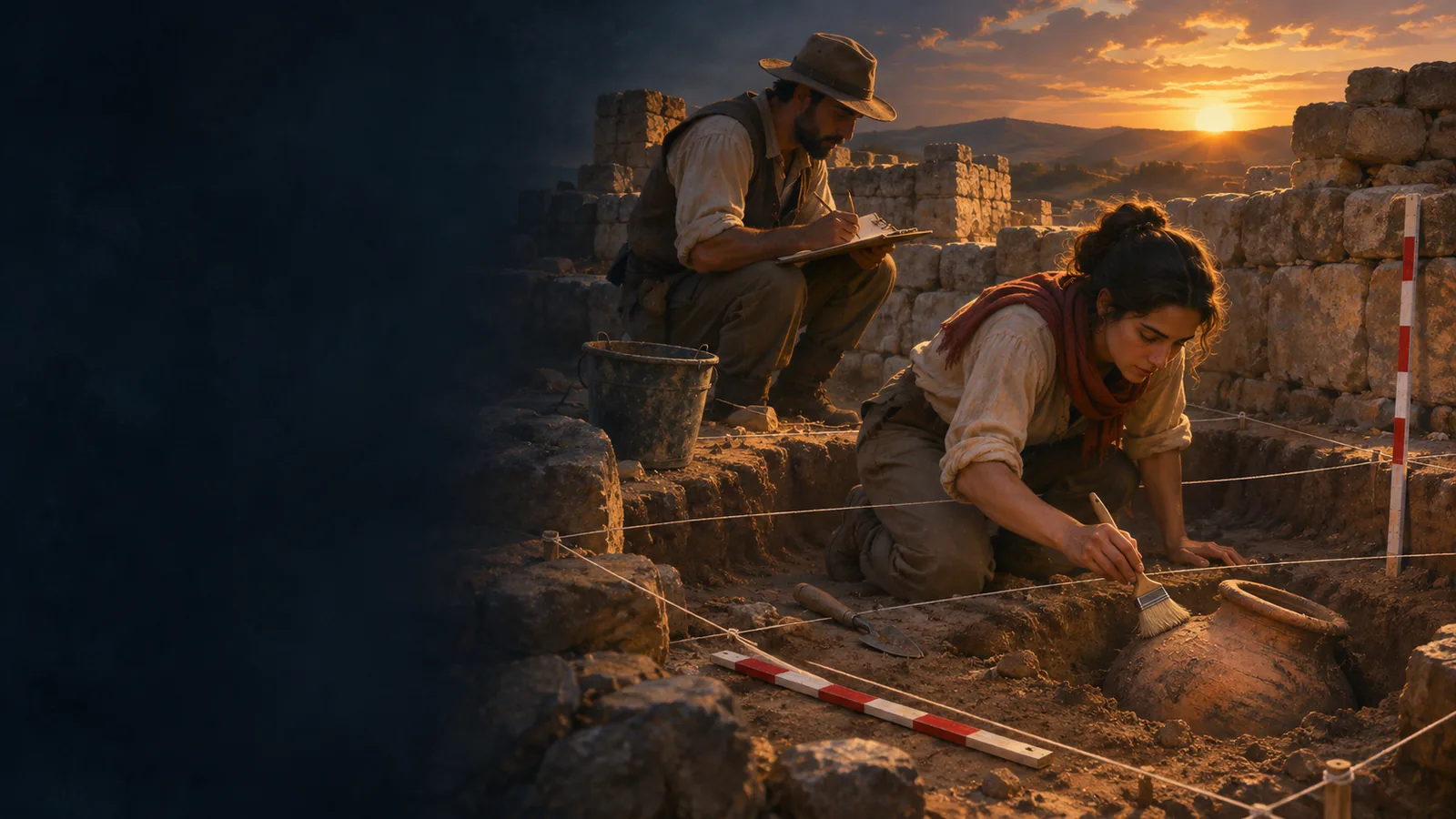
Inscriptions and destruction layers attest many kings, peoples and events from the 9th century BC onward; earlier periods yield settings and debate, while forgeries and unprovenanced objects warn against claims archaeology cannot carry.
Read the field: Biblical archaeologyWhere traditions divide
They divide on the patriarchs, the exodus and the conquest, on the scale of David and Solomon's kingdom, on 10th-century dates, and on whether archaeology should test Scripture at all.
Hermeneutics is reflection on the principles and practice of interpreting Scripture; it runs from inner-biblical and patristic interpretation through Schleiermacher and Gadamer to a global field.
Read the field: HermeneuticsWhere traditions divide
Traditions divide most over who judges a reading: the Magisterium for Catholics, Tradition and the Fathers for Orthodox, Scripture for Reformed and Lutherans, community and Spirit for Anabaptists and Pentecostals.
The procedure of exegesis, from text and translation through context, form and structure to synthesis, is broadly shared across traditions, with historical criticism the common reference point.
Read the field: ExegesisWhere traditions divide
Traditions divide over which methods are legitimate and who governs interpretation, from the Catholic magisterium and the Fathers' consensus to the individual reader with the Spirit.
Biblical theology has no agreed definition or single centre; twelve themes run from Genesis to Revelation and converge in Revelation 21 to 22.
Read the field: Biblical theologyWhere traditions divide
Traditions divide on framing the story as covenants or dispensations or one running principle, and on Israel and the Church; scholars divide over supersessionism.
Most rival readings are ancient, while some, such as dispensationalism, flood geology and King James Onlyism, are recent; a change in how a text is read is distinct from a change in the text.
Read the field: Reception history and history of interpretationWhere traditions divide
Traditions divide on who holds interpretive authority, the teaching office, holy tradition or Scripture itself; scholars divide on whether reception history is a discipline at all.




The theology map