
Why it matters for reading Scripture
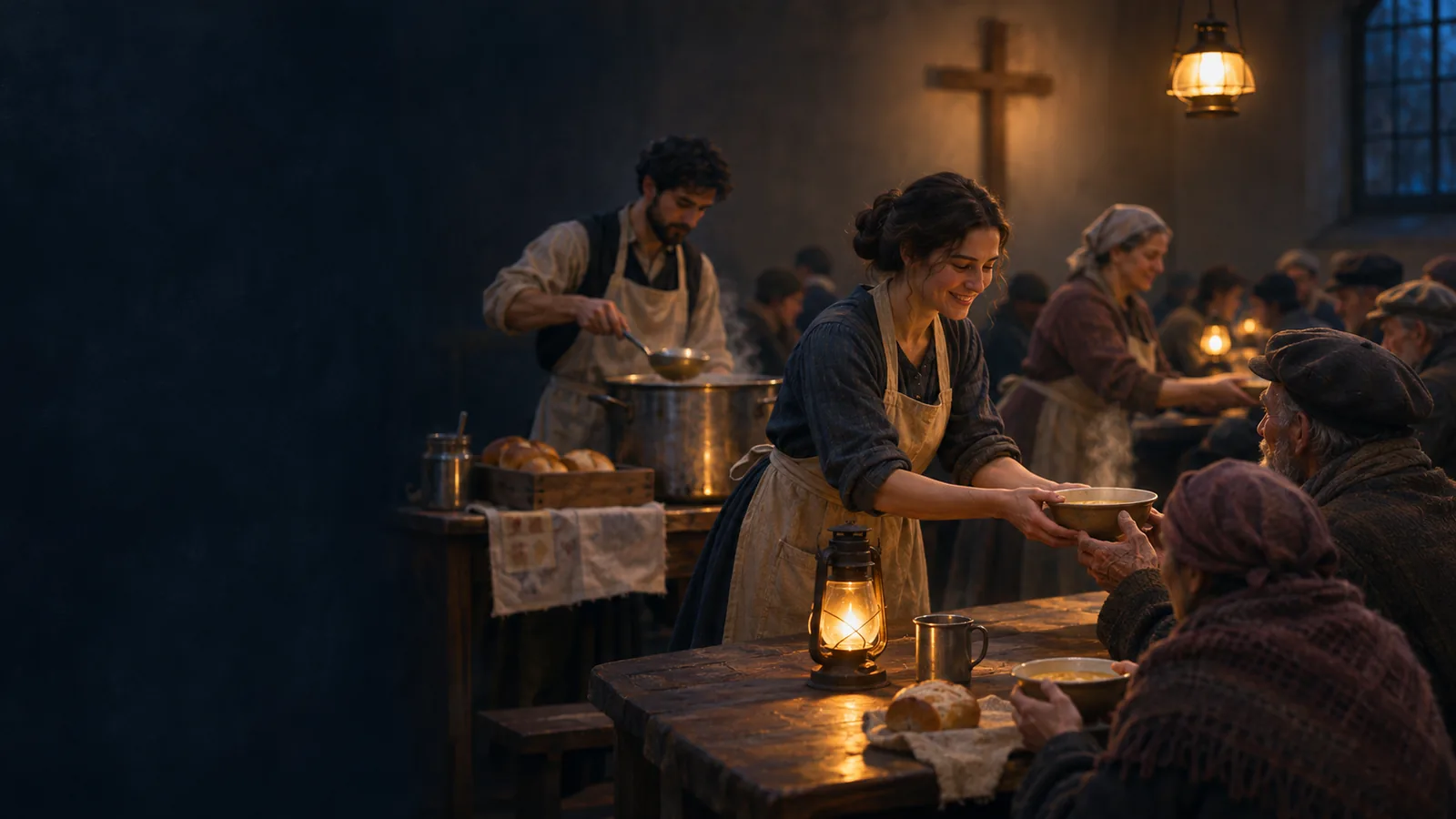
Service to the poor and the sick is a work of the church. It runs from Torah law, Jesus's teaching and the early church through congregations, hospitals, deaconess houses and global agencies.
Practical theologyHow is it lived and shared?
Diaconal studies and social ministry is the study of the church's organized service to the poor, the sick and the vulnerable: where it comes from in Scripture, how it grew into hospitals, deaconess houses and global agencies, and how churches order it today. Also called diaconal science, it studies that practice from biblical, historical, theological, social-scientific and professional angles.
Study v1.1, 7 November 2026
Service to the poor and the sick is a work of the church. It runs from Torah law, Jesus's teaching and the early church through congregations, hospitals, deaconess houses and global agencies.
Service to people in need runs from Torah law, Jesus's teaching and the early church through congregations, hospitals, deaconess houses and global agencies; scholars debate what diakonia meant and how it shapes ordained ministry.
Churches differ on the diaconate as an order, women deacons and evangelism with aid; charity and justice, dependency and state partnership are debated within traditions too.
Treats the diaconate as the first degree of holy orders: the Second Vatican Council restored it in 1964 as a proper and permanent rank of the hierarchy, conferred not unto the priesthood, but unto a ministry of service, and Paul VI set its norms in 1967.
Benedict XVI's Deus Caritas Est (2005) names the ministry of charity beside proclaiming the word and celebrating the sacraments, calls it not a kind of welfare activity that could be left to others, and holds that charity cannot be used as a means of proselytism. His Intima Ecclesiae Natura (2012) places Catholic charitable bodies under the diocesan bishop and requires their staff to share or at least respect their Catholic identity. A papal commission voted 7 to 1 in July 2022 that women cannot at present be admitted to the diaconate as a degree of holy orders, a commission's finding, not a new law or a definitive judgment.
In the Eastern Orthodox churches the male diaconate has continued, with a liturgical role at its center alongside pastoral and, historically, charitable work.
The Patriarchate of Alexandria decided in principle in November 2016 to revive the deaconess ministry, and on 17 February 2017 Patriarch Theodoros II consecrated deaconesses for missionary work at Kolwezi in the Democratic Republic of Congo. On 2 May 2024 Metropolitan Serafim of Zimbabwe ordained Angelic Molen a deaconess near Harare; the Patriarchate's statement of 11 May 2024 said the synod's study of the questions was not complete, and other Orthodox churches have not followed.
Kept deaconesses in convents for centuries.
On 25 September 2017 the Prelate of Tehran ordained Ani-Kristi Manvelian, a lay anesthesiologist, as a parish deaconess, though the church has not formally restored the female diaconate as a whole.
Revived the office of deaconess under Pope Shenouda III, appointing 27 deaconesses in June 1981 for service apart from altar and priestly work.
It set up its Bishopric of Public, Ecumenical and Social Services (BLESS) on 30 September 1962 as its social, diaconal and development arm.
Ordains deacons, usually before priesthood, and its 2001 report For Such a Time as This argued for a renewed distinctive diaconate.
A 2022 study names it with the Catholic Church and British Methodism as churches that have each restored or established a permanent or distinctive diaconate and can learn from one another.
The Lutheran World Federation's Diakonia in Context (2009) calls diakonia the church's "DNA" and frames it as transformation, reconciliation and empowerment.
German Diakonie, with its deacons and deaconesses, shaped the Lutheran diaconate in Europe. In North America the Evangelical Lutheran Church in America voted 864 to 32 in 2016 to create one roster of Ministers of Word and Service, called deacons, and 779 to 105 in 2019 to make ordination their entrance rite; about 1,200 deacons served beside about 16,000 pastors in 2020.
The Methodist Diaconal Order, formed in 1989 from the Wesley Deaconess Order and open to women and men, is both an order of ministry and a religious order, with "witness through service" at its core.
Deacons are the church's officers of mercy, following Calvin's Geneva, whose Ecclesiastical Ordinances of 1541 made them the fourth order of the church, one kind to receive and distribute the goods of the poor, the other to tend the sick.
Reformed churches elect deacons as local officers.
In many Baptist churches deacons are elected locally, and practice, including whether women serve, varies by congregation.
Southern Baptists debate a "board of deacons" model that grew in the nineteenth century and argue for deacons as partners in ministry to the congregation.
Seldom use the language of diaconate, but many run organized social ministries.
The Church of Pentecost in Ghana runs PENTSOS, registered in 1980 and renamed in 1983, with schools, clinics and hospitals, vocational training and credit unions. A study of progressive Pentecostal ministries in 20 countries across Africa, Asia, Latin America and Europe documented programs for children and youth and work to transform individuals and communities.
Their Called to Transformation: Ecumenical Diakonia (June 2022) is read by Jerry Pillay, the WCC's general secretary, as calling diakonia beyond service, charity and relief to transformation, while keeping relief.
The 1974 Lausanne Covenant left evangelism and social responsibility side by side, with evangelism primary.
The Grand Rapids consultation of June 1982, of about fifty evangelical leaders from 27 countries, described social action as a consequence of evangelism, a bridge to it and its partner, like the two blades of a pair of scissors, while keeping a logical priority for evangelism. The debate was sharp: one critic accused John Stott of having "dethroned evangelism".
Steve Corbett and Brian Fikkert's When Helping Hurts (2009), from the Chalmers Center at Covenant College, distinguishes relief, rehabilitation and development and argues that "the failure to distinguish among these situations is one of the reasons that poverty-alleviation efforts often do harm".
It warns against paternalism, doing for people what they can do for themselves. Lynn's review in Missio Dei calls it an introduction, mainstream in its development views, whose principles need more work before they are actionable.
Tearfund's church and community mobilization, also called Umoja ("togetherness" in Swahili), envisions local churches to work with their communities on their own needs with local resources.
Twenty years after a pilot in ten churches, more than ten thousand churches had taken part, and it has been used in more than 40 countries; it draws on participatory rural appraisal and asset-based community development. Its proponents present it as an answer to the dependency critique, because it starts from what a community already has.
Holds that the least are all the needy of the world.
The reading has grown since the late nineteenth century, especially in Catholic teaching and in liberation theology.
Reads the least as Jesus's disciples; a New Testament scholar cited in Christianity Today calls it the majority view in church history and among scholars, a claim no systematic survey was found to test.
A 2026 study reads them as missionaries, and both readings keep the command to care for the poor, which other texts carry.
Justin Martyr describes the Sunday collection: those who are well off give what they choose, it is deposited with the president, and he cares for the orphans and widows, those in want through sickness, and those who are in bonds and the strangers sojourning among us.44
In a letter to Arsacius, high priest of Galatia, traditionally attributed to the emperor Julian and debated since a 2002 argument that it is a later Christian work, Julian orders hostels for strangers in every city and complains that the impious Galilaeans support not only their own poor but ours as well. The church historian Sozomen preserved the letter, which shows how Julian saw Christian charity, not that his own plan was carried out.454647
In the famine of 369 Basil, then a priest and later bishop of Caesarea, organizes feeding of the poor. In a letter to the governor Elias he describes the complex he is building outside the city, with lodging for strangers and care for the sick, served by physicians, doctors, means of conveyance, and escort; a medical historian calls it the first hospital, a claim that depends on how a hospital is defined.4849
The Council of Chalcedon, canon 15, rules that a woman is not to receive the laying on of hands as a deaconess before forty years of age, and only after strict examination. Whether that laying on of hands was an ordination or a blessing is the core of the present dispute.50
Benedict's Rule puts care of the sick before all things and above all things, so that the sick may be served in very deed as Christ himself, quoting Matthew 25.51
Luther publishes the ordinance of the common chest of Leisnig, governed by ten persons chosen by the parish, with a preface urging that the goods of the old foundations go to the common fund of a common chest, out of which gifts and loans might be made, in Christian love, to all the needy. The ordinance was not the first: Wittenberg and Nuremberg had orders in 1522.52535455
Vincent de Paul and Louise de Marillac gather the first Daughters of Charity in Paris to serve the poor in their homes and hospitals.56
Johann Hinrich Wichern founds the Rauhe Haus in Hamburg on 12 September 1833 as a home for neglected children, the first social-diaconal foundation in Germany. On 22 September 1848, at the first Kirchentag in Wittenberg, he calls the church to the Inner Mission; the Central Committee for the Inner Mission followed, the forerunner of today's Diakonie.575859
The Lutheran pastor Theodor Fliedner opens a hospital and deaconess training house at Kaiserswerth on the Rhine with his wife Friederike, and the motherhouse model spreads across Europe and beyond. Florence Nightingale spent two weeks there in July 1850 and returned a year later for three months of training.606162
The Second World War produces the modern church agencies: the US bishops create War Relief Services, now Catholic Relief Services, in 1943; Caritas Internationalis holds its constitutive assembly in Rome on 12 December 1951 with 13 members; and the Lutheran World Federation establishes its World Service in 1952.656667
The Second Vatican Council's Lumen Gentium (21 November 1964) opens the way to a permanent diaconate in the Latin Church, which may be conferred on men of more mature age even if married. Paul VI's Sacrum Diaconatus Ordinem (18 June 1967) sets the norms, leaving each bishops' conference to decide whether to introduce it.12
A papal commission's synthesis, published at Pope Leo XIV's request, reports a 7 to 1 vote, taken in July 2022, that the church cannot at present admit women to the diaconate as a degree of holy orders, while noting that "a purely historical perspective does not allow us to reach any definitive certainty".7736
Approach the practice from several angles at once: biblical, historical, theological, social-scientific and professional7980.
Read the biblical foundations, from the Torah's gleaning and tithe laws and the prophets to the Gospels, Acts, Paul and James8182778384.
Study the diakon- word group across Christian and non-Christian Greek, remembering that context still decides each use and that word usage alone does not decide how the church should serve75.
Trace the history of organized service through its primary documents, such as Justin's account of the Sunday collection, Basil's letter to Elias, Benedict's Rule and the church orders of the Reformation4449515325.
Compare how each church orders the diaconate and its service, naming each position by its holder123.
Read agency figures as each agency's own report for its own year: some report revenue, others spending, people reached or members, and they are agency-reported outputs, not independently assessed outcomes85.
Weigh shares of service by what they measure: facility data and household surveys count different things, so no single continental percentage follows from them7886.
Test practice against the sector's own codes, from the 1994 Code of Conduct to the Dóchas guide and the Core Humanitarian Standard768788.
The works below shaped the field and are cited in this study, from the earliest to the most recent. Hover over a book, or select it, to see its author and the sources behind it.
Listed because this study draws on their published work; no association with or endorsement of Numa Verse is implied. Suggest a correction.
The words that carry the most weight in this field, each defined from the sources of this study. Turn a card over to read its definition.
The older consensus, set out in Hermann Beyer's 1935 dictionary article, held that it meant waiting at table and so humble, lowly service74. John N. Collins argued in 1990 that the words cover message, agency and attendance upon a person, usually under a mandate from someone higher, and Anni Hentschel's 2007 study found that "to serve at the table" is not the basic meaning75103. Collins's reading is an influential challenge, not a settled consensus, and no participant in the debate disputes that Scripture commands care for the poor.
The church has long read them so, though the text does not call them deacons: the Twelve asked for seven men full of the Spirit and wisdom when the Greek-speaking widows were overlooked in the daily distribution of food83. Collins reads their task as a commissioned ministry rather than menial service107.
The churches answer differently. A Catholic commission voted 7 to 1 in July 2022 that women cannot at present be admitted to the diaconate as a degree of holy orders, advice that is not a magisterial decision67. The Patriarchate of Alexandria consecrated deaconesses for mission in 2017 and a metropolitan ordained a deaconess in Zimbabwe in 202489; the Coptic Orthodox Church appointed deaconesses in 198112; and the ELCA and British Methodists admit women as deacons on the same terms as men2023. The texts themselves, Phoebe in Romans 16:1 and the women of 1 Timothy 3:11, are read differently9596.
The 1994 Code of Conduct, a voluntary code, holds that Aid will not be used to further a particular political or religious standpoint76, and Catholic teaching says that charity cannot be used as a means of proselytism3. World Vision states that it never proselytizes or requires a profession of faith for services, while Samaritan's Purse describes its Operation Christmas Child as "dedicated to sharing the Gospel"108109. US rules for faith-based agencies receiving USAID funds required explicitly religious activities to be privately funded, separate in time or place from funded programs and voluntary110.
Africa's Christian Health Associations say they deliver up to 70 percent of services in some countries111. Olivier and Wodon found the basis of such claims often unclear; on World Bank data, facility data put the faith share at 30 to 40 percent, while household surveys typically put it below 10 percent8678. Country shares vary widely, from 10 to 20 percent in Chad to 50 to 70 percent in the Democratic Republic of Congo, and the figures measure different things, so no single continental percentage follows from them112.
Reviewed and approved by Duane Herholdt, BA (Theology), Chief Executive Officer, Numa Verse
Study version: v1.1, 7 November 2026 (theology map v1.27)
Last reviewed: 9 November 2026