Numa Verse

Practical theologyHow is it lived and shared?

Liturgy and worship, with church music

What is liturgy and worship, with church music?

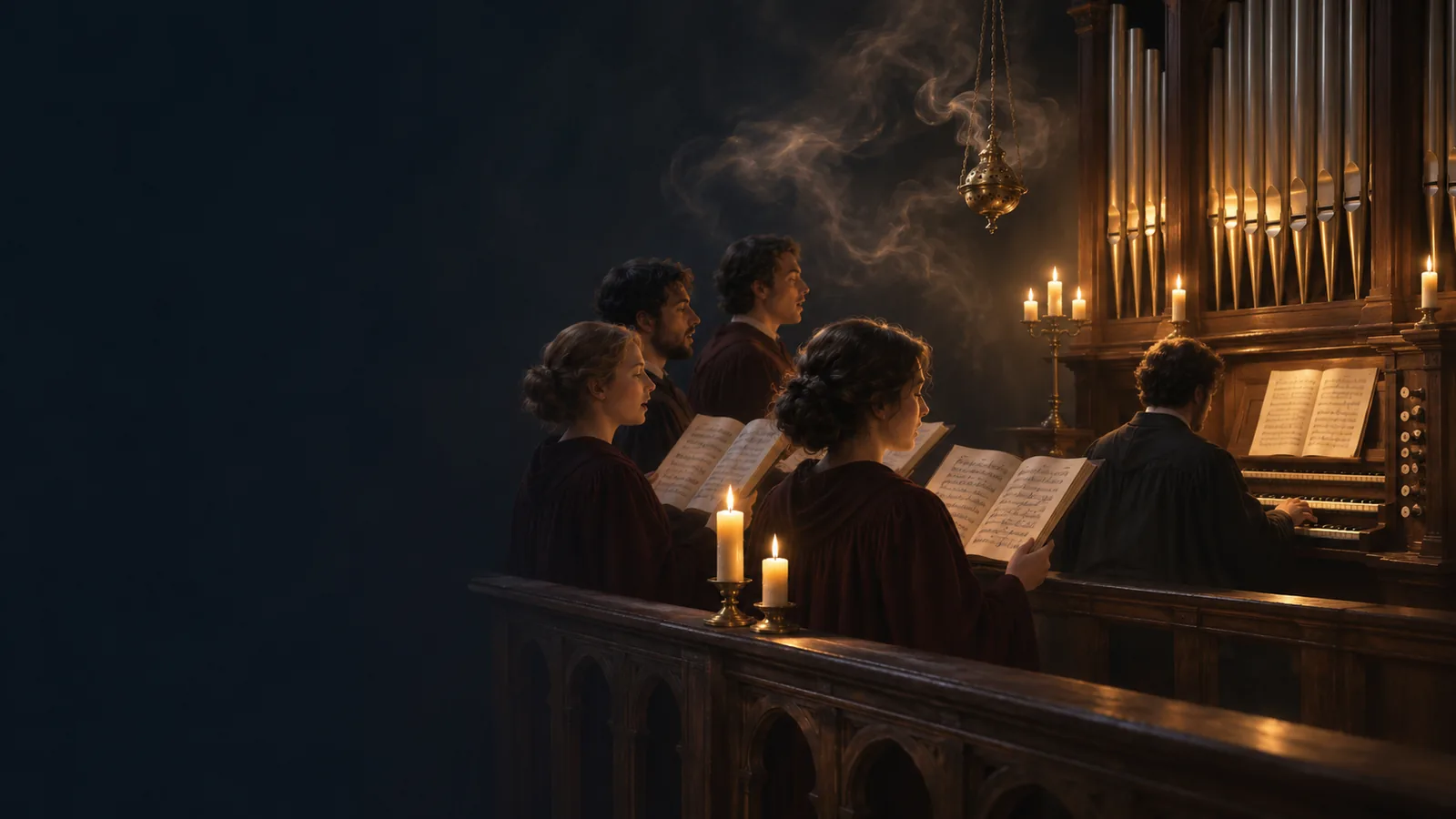
Liturgy and worship, with church music, is the study of how the churches pray, worship and sing. Liturgy names public, ordered worship, above all the Eucharist; worship is the wider act of honoring God, set or free. It covers the early and historic rites, the church year, lectionaries and church music, and treats worship as a source of theology.

  • 89Sources
  • 14Traditions
  • 16Dated entries
  • 13Minutes

Study v1.1, 5 November 2026

At a glance

Why it matters for reading Scripture

How the churches pray and worship. Many passages are known first through worship, and traditions differ on its form.

What the study found

Christian worship drew on Jewish Scripture, psalmody and prayer and the Lord's Supper, forming rite families and Reformation orders; most churches share Scripture, psalms and the Lord's Prayer, but differ on Communion frequency and calendar.

Where traditions divide

Traditions divide on set liturgy against free worship, what Scripture permits in worship, instruments and hymns, women leading, Latin or vernacular, Old or New Calendar, and contemporary worship music.

How the traditions compare

  • Roman Catholic Church

    Worships from authorized texts such as the Roman Missal, and makes "full and active participation by all the people" the aim to be considered before all else.

    It grounds its worship in received tradition as well as Scripture, as the Catechism's statement that the Church "believes as she prays" shows. The Second Vatican Council kept Latin in the Latin rites while allowing the vernacular to be extended, and held the pipe organ in high esteem; the 1967 instruction Musicam Sacram admits other instruments suited to sacred use. Since Traditionis Custodes (2021) the 1962 Missal is permitted only under the bishop's authority, and since 2021 lay women and men may be admitted to the instituted ministries of lector and acolyte.

    Sources1–7
  • Eastern Orthodox Church

    Worships from the authorized text of the Divine Liturgy, normally that of St John Chrysostom.

    The Orthodox Church in America states that the tradition of the Orthodox Church is to have no musical instruments in church, though organs are found in some Greek and Antiochian parishes in the United States. Orthodox churches divide over the Revised Julian calendar for fixed feasts, but all compute Easter on the Julian calendar, so Western and Orthodox Easter usually differ.

    Sources8–11
  • Old Calendarists

    Call themselves Genuine or True Orthodox and hold that the Church may not change its calendar, citing its long use and sixteenth-century Orthodox condemnations of the Gregorian reform.

    Churches using the revised calendar answer that it moves only fixed feasts and keeps the Orthodox Paschal reckoning. Keeping the Julian calendar is not itself Old Calendarism: most churches that keep Christmas on 7 January remain in communion with those that keep 25 December.

    Sources1012
  • Oriental Orthodox churches

    Worship from authorized texts: the Qeddase in the Ethiopian and Eritrean Orthodox Tewahedo churches, the Badarak in the Armenian Apostolic Church, and three liturgies, of St Basil, St Gregory of Nazianzus and St Cyril, in the Coptic Orthodox Church.

    Ge'ez remains the liturgical language of the Ethiopian church, alongside the people's language, and the church's own account names a large drum, a sistrum and a hand-bell in its music.

    Sources13–16
  • Anglican

    Worships from the Book of Common Prayer and other authorized books.

    The Articles of Religion give the Church "power to decree Rites or Ceremonies" and each national church authority to change them, provided nothing is ordained against God's Word written. With the Lutheran position, this is often summarized as a normative principle.

    Sources17–18
  • Lutheran

    Worships from Lutheran orders that go back to Luther's Formula Missae (1523) and Deutsche Messe (1526).

    The Augsburg Confession holds that human ceremonies need not be alike everywhere, and keeps rites that may be observed without sin and serve order and peace.

    Sources19–21
  • Reformed (regulative principle)

    The Westminster Confession allows in worship only what Scripture prescribes, and its defenders state this as a charter of liberty: "God alone is Lord of the conscience", so no church may impose worship that Scripture does not command.

    Circumstances of worship are left to Christian prudence, and the Westminster Directory gave headings for prayer instead of fixed texts. Reformed churches that hold the principle differ over whether hymns and instruments meet its test.

    Sources22–23
  • Exclusive psalmody

    In its strictest form the regulative principle excludes both hymns and instruments.

    The Free Presbyterian Church of Scotland excludes "all materials of praise other than the inspired Psalms" and allows "only the human voice", and the Reformed Presbyterian Church of North America holds "a capella singing and the exclusive use of the Psalms".

    Sources24–25
  • Methodist

    John Wesley's Sunday Service (1784) was his abridgement and revision of the 1662 Prayer Book.

    Methodists on the American frontier set it aside for extemporaneous prayer, while British Methodists used Wesley's abridgement alongside the Prayer Book.

    Sources26–27
  • Quakers

    Quakers in Britain describe worship as a shared act that is "never" an individual activity and prize "silent waiting upon the Lord".

    A meeting has no set leader and any Friend may minister; spoken ministry should come from a sense of leading.

    Sources28
  • Pentecostal and charismatic

    Services leave room for the gifts of the Spirit: in seven of the ten countries Pew surveyed in 2006, at least half of Pentecostals said their services often include them.

    Raised hands, shouting and dance belong to the worship, as the Azusa Street accounts describe.

    Sources29–30
  • Churches of Christ (Stone-Campbell)

    The churches of Christ of the Stone-Campbell movement mostly worship without instruments, holding that instruments are an unauthorized change from the early church.

    The Christian churches of the same movement use them as a matter of congregational choice.

    Sources31–32
  • Contemporary worship music: supporters

    Swee Hong Lim and Lester Ruth trace contemporary worship to the vernacular worship of the post-war decades, the choruses of the Jesus People and above all Pentecostal practice, in which a time of praise leads the congregation into the presence of God.

    Supporters also point to participation, accessible language and songs that congregations learn quickly.

    Sources33–34
  • Contemporary worship music: critics

    Ask what a narrow set of sources and a commercial market do to the breadth of what churches sing; one study of the CCLI and PraiseCharts Top 25 lists tied 37 of 38 leading songs released from 2010 to 2020 to five churches.

    The researchers themselves draw no conclusion on theology, and Leah Payne attributes the concentration to the fact that most worshippers attend large churches.

    Sources35–36

How the field developed

  1. Early church
    Mid 2nd century

    Justin Martyr's First Apology, written in Rome, gives the first full outline of a Sunday service: readings, instruction, prayer, bread, wine and water, thanksgiving and a collection for those in need. Justin gives two reasons for Sunday: God began creation on that day, and Christ rose on it.37

  2. Late antiquity
    325

    The Council of Nicaea does not fix the date of Easter by a numbered canon, but its synodal letter reports agreement that the churches of the East keep the feast at the same time as Rome and Alexandria. The council tells Christians to pray standing on Sundays and through the fifty days of Pentecost.38

  3. Late antiquity
    Late 4th century

    Egeria, a pilgrim, describes worship in Jerusalem: hymns and psalms before dawn, prayer at fixed hours, a Sunday vigil with the reading of the Resurrection, an eight-day Epiphany feast and an eight-week Lent.39

  4. Late antiquity
    6th century

    The Ethiopian Church traces its chant, zema, and the three modes still in use to Yared, a sixth-century Aksumite composer and saint, whose hymnary, the Deggwa, is described as the oldest literary work in Ge'ez.4016

  5. Reformation
    1523 and 1526

    Luther publishes the Formula Missae, in Latin, which keeps much of the historic Mass but removes the Canon, and then the Deutsche Messe, a German service with hymns in place of much of the old text.1920

  6. Reformation
    1549 to 1662

    The Church of England's first Book of Common Prayer appears in 1549, followed by the books of 1552 and 1559; the 1662 book is described as the current official Prayer Book.17

  7. Reformation
    1562

    The Genevan Psalter, begun by Calvin in Strasbourg in 1539, is completed with all 150 psalms, in texts by Clément Marot and Théodore de Bèze. The complete psalter uses 125 tunes in 110 meters, almost all syllabic.414243

  8. Reformation
    January 1645

    A Parliamentary ordinance orders that the Book of Common Prayer "shall not be used" and the Westminster Directory for the Public Worship of God "shall be observed". The Directory gives headings and the sense of prayers rather than fixed texts.4423

  9. Modern
    1784

    John Wesley sends the American Methodists The Sunday Service of the Methodists in North America, his abridgement and revision of the 1662 Prayer Book.2645

  10. Modern
    1867 and 1871

    Slave Songs of the United States, the first published collection of spirituals, appears in 1867. In 1871 Fisk University sends out its Jubilee Singers, who begin singing spirituals as encores, and the response makes them the core of their concerts.4647

  11. Modern
    1906

    The Azusa Street revival in Los Angeles, led by William Seymour from April 1906 to about 1909, is widely treated as the start of the worldwide Pentecostal movement.4830

  12. Modern
    May 1923

    An inter-Orthodox congress at Constantinople under Patriarch Meletios IV, not attended by all churches, adopts a revised calendar for fixed feasts; Easter is still computed on the Julian calendar.10

  13. Modern
    1926

    Virgil Michel founds Orate Fratres at Saint John's Abbey, Collegeville, on the First Sunday of Advent. It carries the liturgical movement into the English-speaking world, and in 1951 takes the name Worship to signal support for the vernacular.49

  14. Modern
    4 December 1963

    The Second Vatican Council promulgates Sacrosanctum Concilium, which makes "full and active participation by all the people" the aim to be considered before all else and asks that "a more representative portion of the holy scriptures" be read over a set number of years.2

  15. Modern
    1969

    Paul VI's constitution Missale Romanum adds three new Eucharistic Prayers and sets Sunday readings on a three-year cycle, and the Roman Lectionary for Mass gives three readings on Sundays, from the Old Testament, an apostle and the Gospel.150

  16. Modern
    1992

    The North American Consultation on Common Texts publishes the Revised Common Lectionary, reworking the adaptations that many Protestant churches had made of the 1969 Roman lectionary.51

How to study liturgy and worship, with church music

The questions it asks

  • What do liturgy, rite, office and ordo mean, and how is worship studied?5253
  • Where did Christian worship come from, and what do the earliest sources actually show?
  • How far can Christian worship be traced to the temple and the synagogue?
  • How do rites grow, and what are the great rites of East and West?54
  • Does the Church believe as it prays, so that worship is a source of theology?3
  • How does each church keep its calendar and choose its readings?
  • How do the churches sing, from chant to metrical psalms, hymns, spirituals and contemporary worship music?

Its method

Start
  1. Read the earliest sources, the Didache, Justin Martyr, the Apostolic Tradition and Egeria, with the disputes over their date and authorship5537565739.

  2. Separate historical liturgics, which establishes structures and their development, from liturgical theology, which discovers their meaning58.

  3. Compare rites by Baumstark's comparative method, which studies how rites grow by small local steps, as Robert Taft did for the Byzantine Divine Liturgy5459.

  4. Group the rites in their families, Antiochene, Alexandrian, Gallican and Roman, as later scholarship has refined that map60.

  5. Describe each rite from its own texts and official sources: its structure, language and texts861.

  6. Read the lectionaries to see which parts of Scripture each church reads aloud and how it pairs Old and New Testament readings506263.

  7. Treat the so-called laws of liturgical development as contested: a 2018 article argues that liturgy behaves less like an evolving species than like a self-regulating ritual system64.

  8. Where sources disagree, give each with its own hedges, as with the rival reconstructions of the Apostolic Tradition5657.

What to read

Its primary witnesses

  • The Didache, an early church order with prayers over the cup and bread and instructions on baptism and the Lord's day55.
  • Justin Martyr's First Apology, with the first full outline of a Sunday service37.
  • The Apostolic Tradition, the most contested of the early church orders5657.
  • Egeria's account of worship in Jerusalem in the late fourth century, incomplete where the manuscript is damaged39.
  • The Divine Liturgy of St John Chrysostom and the Liturgy of St Basil, used ten times a year865.
  • The three Coptic liturgies, of St Basil, St Gregory of Nazianzus and St Cyril15.
  • The Ethiopian Qeddase, with fourteen anaphoras in the standard English translation of 195913.
  • The Armenian Badarak and the Maronite Qurbono1466.
  • The Roman Missal, from Quo primum (1570) to Paul VI's Missale Romanum of 1969671.
  • The Book of Common Prayer from 1549 to 1662, and the Westminster Directory of 16451744.
  • Hymnals and chant books: the Genevan Psalter, the Ausbund, the Octoechos, the Beth Gazo and the Shembe hymns4168697071.

Standard reference works

  • Alexander Schmemann, Introduction to Liturgical Theology (Russian 1961; English 1966)72.
  • Aidan Kavanagh, On Liturgical Theology (1984)7374.
  • Gordon Lathrop's trilogy Holy Things (1993), Holy People (1999) and Holy Ground (2003)53.
  • Geoffrey Wainwright, Doxology: The Praise of God in Worship, Doctrine and Life (1980)75.
  • Anton Baumstark, On the Historical Development of the Liturgy (1923; English 2011)54.
  • Paul Bradshaw, Maxwell Johnson and Edward Phillips, The Apostolic Tradition: A Commentary (2002), and Alistair Stewart's On the Apostolic Tradition (second edition, 2015)5657.
  • Luther's Works, volume 53, which collects Luther's liturgical writings, hymns and music19.
  • The General Instruction of the Roman Missal (2002) and the Lectionary for Mass (1969, revised 1981)7650.
  • The Revised Common Lectionary (1992)51.
  • Swee Hong Lim and Lester Ruth, Lovin' on Jesus (2017), the first scholarly history of contemporary worship33.
  • The journals Studia Liturgica, founded in 1962, and Worship, founded as Orate Fratres in 1926777849.

Scholarship referenced in this study

The works below shaped the field and are cited in this study, from the earliest to the most recent. Hover over a book, or select it, to see its author and the sources behind it.

  • 1910LiturgyAdrian FortescueLiturgy (1910)Adrian FortescueSources60
  • 1923On the Historical Development of the LiturgyAnton BaumstarkOn the Historical Development of the Liturgy (1923)Anton Baumstark (1872 to 1948)Sources54
  • 1961 and 1966Introduction to Liturgical TheologyAlexander SchmemannIntroduction to Liturgical Theology (1961 and 1966)Alexander Schmemann (1921 to 1983)Sources72
  • 1977How Liturgies Grow: The Evolution of the Byzantine Divine LiturgyRobert TaftHow Liturgies Grow: The Evolution of the Byzantine Divine Liturgy (1977)Robert TaftSources59
  • 1980Doxology: The Praise of God in Worship, Doctrine and LifeGeoffrey WainwrightDoxology: The Praise of God in Worship, Doctrine and Life (1980)Geoffrey WainwrightSources75
  • 1984On Liturgical TheologyAidan KavanaghOn Liturgical Theology (1984)Aidan Kavanagh (1926 to 2006)Sources73–74
  • 1993Holy ThingsGordon LathropHoly Things (1993)Gordon LathropSources53
  • 1999Rituals of Fertility and the Sacrifice of DesireCarol MullerRituals of Fertility and the Sacrifice of Desire (1999)Carol MullerSources79
  • 2002The Apostolic Tradition: A CommentaryPaul BradshawThe Apostolic Tradition: A Commentary (2002)Paul Bradshaw, with Maxwell Johnson and Edward PhillipsSources56
  • 2015On the Apostolic TraditionAlistair StewartOn the Apostolic Tradition (2015)Alistair StewartSources57
  • 2017Lovin' on Jesus: A Concise History of Contemporary WorshipSwee Hong LimLovin' on Jesus: A Concise History of Contemporary Worship (2017)Swee Hong Lim, with Lester RuthSources33–34

Listed because this study draws on their published work; no association with or endorsement of Numa Verse is implied. Suggest a correction.

Key terms

The words that carry the most weight in this field, each defined from the sources of this study. Turn a card over to read its definition.

The church's public, ordered worship, above all the Eucharist.

The wider act of honoring God, set or free.

A historically distinct body of worship, with its texts, ceremonial, chant and calendar, proper to a church or family of churches52.

The daily office: the cycle of prayer at fixed hours, which Egeria already found in Jerusalem in the fourth century39.

Both the book that orders a service and, in liturgical theology, the underlying pattern that makes worship recognizably Christian; Gordon Lathrop sets it out as bath, word, table and prayer53.

The phrase that ties prayer to belief; the Catechism of the Catholic Church states that "the law of prayer is the law of faith: the Church believes as she prays"3.

Aidan Kavanagh's name for the liturgy as primary theology, from which secondary, systematic theology is drawn74.

The principle, stated in the Westminster Confession, that allows in worship only what Scripture prescribes22.

The Byzantine book of the eight tones, which collects the hymns of the weekly cycle8069.

Reading a psalm line by line before it is sung, where many could not read81.

Questions people ask

Many Orthodox churches compute Easter on the Julian calendar, now thirteen days behind the Gregorian10. In 2026 Western Easter fell on 5 April and Orthodox Easter on 12 April; in 2027 they fall on 28 March and 2 May, and in 2028 both fall on 16 April8211. On 29 November 2025 Leo XIV and Ecumenical Patriarch Bartholomew signed a joint declaration committing them to "continue the process of exploring a possible solution for celebrating together the Feast of Feasts every year"83.

The usual Byzantine Divine Liturgy has none63. The exceptions are the Liturgies joined to Vespers, on Holy Thursday, Holy Saturday and in some years the eves of the Nativity and Theophany and the Annunciation84. Otherwise Old Testament readings come at Vespers on the eves of feasts, and on weekdays of Great Lent Isaiah is read at the Sixth Hour and Genesis and Proverbs at Vespers8586.

It was identified in the early twentieth century as his work57. Paul Bradshaw, Maxwell Johnson and Edward Phillips argue that it is neither by Hippolytus nor by any one author, but a composite of layers of diverse origin compiled over time, while Alistair Stewart sees a stronger Roman and Hippolytan connection and places it broadly in the third century568757. The question matters because the second Eucharistic Prayer of the 1970 Roman Missal draws on its anaphora88.

The Orthodox Church in America states that the tradition of the Orthodox Church is to have no musical instruments in church, and that the instruments of Psalm 150 did not carry into Christian worship9. Most churches of Christ hold that instruments are an unauthorized change from the early church31. Some Reformed churches sing psalms only, with "only the human voice", on the strictest form of the regulative principle2425. The Catholic Church, by contrast, holds the pipe organ in high esteem2.

In part: the Roman lectionary and the Revised Common Lectionary share a three-year Gospel pattern, reading mostly Matthew in Year A, Mark in Year B and Luke in Year C8962. They pair the Old Testament with the Gospel differently: the Roman lectionary selects Old Testament texts mainly for their correlation with the New Testament readings, while the Revised Common Lectionary offers, after Pentecost, a semicontinuous track beside a complementary track tied to the Gospel5062.

Contribute to liturgy and worship, with church music

Register to contribute

  1. 1Apostolic Constitution Missale Romanum, 3 April 1969 (The Holy See)https://www.vatican.va/content/paul-vi/en/apost_constitutions/documents/hf_p-vi_apc_19690403_missale-romanum.html (opens in a new tab)
  2. 2Sacrosanctum Concilium, 4 December 1963 (The Holy See)https://www.vatican.va/archive/hist_councils/ii_vatican_council/documents/vat-ii_const_19631204_sacrosanctum-concilium_en.html (opens in a new tab)
  3. 3Catechism of the Catholic Church 1124 (Vatican archive)https://www.vatican.va/archive/ENG0015/__P32.HTM (opens in a new tab)
  4. 4Musicam Sacram, 5 March 1967 (The Holy See)https://www.vatican.va/archive/hist_councils/ii_vatican_council/documents/vat-ii_instr_19670305_musicam-sacram_en.html (opens in a new tab)
  5. 5Traditionis Custodes, 16 July 2021 (The Holy See)https://www.vatican.va/content/francesco/en/motu_proprio/documents/20210716-motu-proprio-traditionis-custodes.html (opens in a new tab)
  6. 6Vatican liturgy chief says Pope Leo will not overturn Latin Mass restrictions (Herald Malaysia, CNS)https://www.heraldmalaysia.com/news/vatican-liturgy-chief-says-pope-leo-will-not-overturn-latin-mass-restrictions/90668/1 (opens in a new tab)
  7. 7Spiritus Domini, 10 January 2021 (The Holy See)https://www.vatican.va/content/francesco/en/motu_proprio/documents/papa-francesco-motu-proprio-20210110_spiritus-domini.html (opens in a new tab)
  8. 8The Divine Liturgy of Saint John Chrysostom (Greek Orthodox Archdiocese of America)https://www.goarch.org/-/the-divine-liturgy-of-saint-john-chrysostom (opens in a new tab)
  9. 9Questions and Answers: Musical Instruments (Orthodox Church in America)https://www.oca.org/questions/parishlife/musical-instruments (opens in a new tab)
  10. 10The Calendar of the Orthodox Church (Church of the Mother of God)https://churchmotherofgod.org/articles/the-calendar-of-the-orthodox-church/ (opens in a new tab)
  11. 11Orthodox Easter Day (Time and Date)https://www.timeanddate.com/holidays/us/orthodox-easter-day (opens in a new tab)
  12. 12Old Calendarism: A Problem Interpreting Tradition?, Fox, 6 February 2023 (Catholic Stand)https://catholicstand.com/?p=77261 (opens in a new tab)
  13. 13The Liturgy of the Ethiopian Church, trans. Marcos Daoud, rev. Marsie Hazen, 1959 (Ethiopian Orthodox Church, PDF)https://mail.ethiopianorthodox.org/biography/englishethiopianliturgy.pdf (opens in a new tab)
  14. 14Divine Liturgy (St John Armenian Apostolic Orthodox Church)https://www.stjohnarmenianchurch.org/divine-liturgy (opens in a new tab)
  15. 15Liturgies of the Coptic Orthodox Church (Coptic Orthodox Diocese of Los Angeles)https://lacopts.org/orthodoxy/coptic-orthodox-church/liturgies-of-the-coptic-orthodox-church (opens in a new tab)
  16. 16Church Music (Ethiopian Orthodox Tewahedo Church)https://www.ethiopianorthodox.org/english/church/music.html (opens in a new tab)
  17. 17Church of England Books of Common Prayer (Society of Archbishop Justus)https://justus.anglican.org/resources/bcp/england.htm (opens in a new tab)
  18. 18Articles of Religion XX and XXXIV (Church of England)https://www.churchofengland.org/liturgy/book-of-common-prayer/articles-religion (opens in a new tab)
  19. 19Luther's Works, Volume 53: Liturgy and Hymns, ed. Leupold (Fortress Press)https://www.fortresspress.com/store/product/9780800603533/Luthers-Works-Volume-53 (opens in a new tab)
  20. 20Wilhelm Löhe's Hauptgottesdienst (1844) as Critique of Luther's Deutsche Messe, Fenton, CTQ 64:2 (Concordia Theological Seminary)https://media.ctsfw.edu/Item/GetFullText/160 (opens in a new tab)
  21. 21Augsburg Confession (1530) VII and XV, Schaff, Creeds of Christendom III (CCEL)https://ccel.org/ccel/schaff/creeds3.iii.ii.html (opens in a new tab)
  22. 22Westminster Confession of Faith 21.1 and 21.5 (Orthodox Presbyterian Church)https://opc.org/wcf.html (opens in a new tab)
  23. 23Westminster and Ordination: The Directory of Worship (Place for Truth)https://placefortruth.org/?p=2835 (opens in a new tab)
  24. 24The Regulative Principle of Worship (Free Presbyterian Church of Scotland)https://www.fpchurch.org.uk/about-us/important-documents/the-regulative-principle-of-worship/ (opens in a new tab)
  25. 25The Doctrine and History of Worship in the Reformed Presbyterian Church of North America, Delivuk, STM thesis 1982 (CORE)https://core.ac.uk/download/482745356.pdf (opens in a new tab)
  26. 26MS Revd (1784-85), editorial introduction (Center for Studies in the Wesleyan Tradition, Duke Divinity School)https://divinity.duke.edu/sites/default/files/documents/64_MS_Revd.pdf (opens in a new tab)
  27. 27Wesley's Sunday Service of the People Called Methodists, chapter abstract, Burns and Gribben eds, 2019 (Academia.edu)https://www.academia.edu/38912542 (opens in a new tab)
  28. 28Quaker faith and practice, 5th edition, chapter 2 (Britain Yearly Meeting)https://qfp.quaker.org.uk/chapter/2/ (opens in a new tab)
  29. 29Spirit and Power: A 10-Country Survey of Pentecostals, 5 October 2006 (Pew Research Center)https://www.pewresearch.org/religion/2006/10/05/spirit-and-power/ (opens in a new tab)
  30. 30Pentecostalism: William Seymour, Christian History 65 (Christian History Institute)https://christianhistoryinstitute.org/magazine/article/pentecostalism-seymour (opens in a new tab)
  31. 31Restoration Forum: Catalyst for Change (Christian Standard)https://christianstandard.com/?p=768 (opens in a new tab)
  32. 32Churches of Christ (EBSCO Research Starters)https://www.ebsco.com/research-starters/religion-and-philosophy/churches-christ (opens in a new tab)
  33. 33Lovin' on Jesus: A Concise History of Contemporary Worship, Lim and Ruth (Abingdon Press)https://www.abingdonpress.com/product/9781426795138 (opens in a new tab)
  34. 34Everett, review of Lim and Ruth, Lovin' on Jesus (Modern Reformation)https://www.modernreformation.org/resources/articles/the-mod-lovin-on-jesus-a-concise-history-of-contemporary-worship-by-swee-hong-lim-and-lester-ruth (opens in a new tab)
  35. 35100% of the top 25 worship songs are associated with just a handful of megachurches (Worship Leader Research)https://worshipleaderresearch.com/100-of-the-top-25-worship-songs-are-associated-with-just-a-handful-of-megachurches/ (opens in a new tab)
  36. 36There's a reason every hit worship song sounds the same, 11 April 2023 (Religion News Service)https://religionnews.com/2023/04/11/theres-a-reason-every-hit-worship-song-sounds-the-same/ (opens in a new tab)
  37. 37First Apology 67, Justin Martyr, ANF 1 (CCEL)https://ccel.org/ccel/schaff/anf01.viii.ii.lxvii.html (opens in a new tab)
  38. 38First Council of Nicaea (325), Canons and Synodal Letter (New Advent)https://www.newadvent.org/fathers/3801.htm (opens in a new tab)
  39. 39The Pilgrimage of Etheria, ed. McClure and Feltoe, SPCK 1919 (CCEL)https://www.ccel.org/m/mcclure/etheria/etheria.htm (opens in a new tab)
  40. 40Yared (B) (Dictionary of African Christian Biography)https://dacb.org/stories/ethiopia/yared2/ (opens in a new tab)
  41. 41The Genevan Psalter: 450 years, de Visser, Clarion 61 (2012) (Canadian Reformed Theological Seminary)https://canadianreformedseminary.ca/files/deVisser-The%20Genevan%20Psalter%20-%20450%20years.pdf (opens in a new tab)
  42. 42The Tunes of the Genevan Psalter 1562, Wursten (dick.wursten.be)https://dick.wursten.be/psalmsmusic/melodies-geneva.html (opens in a new tab)
  43. 43The Genevan Psalter, introduction, Reynolds (genevanpsalter.com)https://genevanpsalter.com/files/articles/Gen_Psal_intro_Reynolds.pdf (opens in a new tab)
  44. 44January 1645: Ordinance for taking away the Book of Common Prayer and establishing the Directory (British History Online)https://prod.british-history.ac.uk/node/47669 (opens in a new tab)
  45. 45Collection of Psalms and Hymns (1784), editorial introduction (Duke Divinity School)https://divinity.duke.edu/sites/default/files/documents/31_Collection_of_Psalms_and_Hymns_%281784%29.pdf (opens in a new tab)
  46. 46The First Publications of the Spiritual (St Olaf College American Music blog)https://pages.stolaf.edu/americanmusic/2019/10/16/the-first-publications-of-the-spiritual/ (opens in a new tab)
  47. 47Jubilee Singers of Fisk University, Reavis L. Mitchell Jr. (Tennessee Encyclopedia)https://tennesseeencyclopedia.net/entries/jubilee-singers-of-fisk-university/ (opens in a new tab)
  48. 48Azusa Street Revival (1906-1909) (BlackPast)https://blackpast.org/aaw/azusa-street-revival-1906-1909 (opens in a new tab)
  49. 49Publishing (Saint John's Abbey)https://saintjohnsabbey.org/publishing (opens in a new tab)
  50. 50Lectionary for Mass, General Introduction, chapter IV (Diocese of Laredo)https://dioceseoflaredo.org/wp-content/uploads/2024/04/ChapterIVGeneralArangementofReadingsforMass.pdf (opens in a new tab)
  51. 51Revised Common Lectionary (Consultation on Common Texts)https://www.commontexts.org/rcl/ (opens in a new tab)
  52. 52Ethiopian Anaphora of the Apostles (Saint Dominic's Media encyclopedia)https://www.saintdominicsmedia.com/encyclopedia/ethiopian-anaphora-of-the-apostles/ (opens in a new tab)
  53. 53Liturgins grammatik i nordisk kontext, abstract (Svensk Gudstjänstliv)https://journals.lub.lu.se/sgl/article/view/21376 (opens in a new tab)
  54. 54Anton Baumstark: On the Historical Development of the Liturgy (Communio blog)https://communio.stblogs.org/?p=26793 (opens in a new tab)
  55. 55Didache, trans. Roberts and Donaldson (New Advent)https://www.newadvent.org/fathers/0714.htm (opens in a new tab)
  56. 56The Apostolic Tradition: A Commentary, Bradshaw, Johnson and Phillips (Fortress Press)https://www.fortresspress.com/store/product/9780800660468/The-Apostolic-Tradition (opens in a new tab)
  57. 57On the Apostolic Tradition, trans. Alistair Stewart, 2nd edition, PPS 54 (SVS Press)https://svspress.com/on-the-apostolic-tradition-hippolytus-second-edition (opens in a new tab)
  58. 58Introduction to Liturgical Theology, product page (St Tikhon's Monastery Press)https://stmpress.com/products/introduction-to-liturgical-theology (opens in a new tab)
  59. 59How Liturgies Grow: The Evolution of the Byzantine Divine Liturgy, Robert Taft, OCP 43 (1977) (jbburnett.com PDF)https://mail.jbburnett.com/resources/taft,%20evolution%20of%20ltg.pdf (opens in a new tab)
  60. 60Liturgy, Adrian Fortescue, Catholic Encyclopedia 1910 (New Advent)https://www.newadvent.org/cathen/09306a.htm (opens in a new tab)
  61. 61The Divine Liturgy (Orthodox Church in America)https://www.oca.org/orthodoxy/the-orthodox-faith/worship/the-divine-liturgy (opens in a new tab)
  62. 62Revised Common Lectionary FAQ (Vanderbilt Divinity Library)https://lectionary.library.vanderbilt.edu/faq2.php (opens in a new tab)
  63. 63The Gospel Lectionary in the Byzantine Church, Petras (Holy Trinity Orthodox Church, PDF)https://www.trinityorthodox.ca/sites/default/files/Petras-TheGospelLectionaryInTheByzantineChurch.pdf (opens in a new tab)
  64. 64Ritual Systems, Ritualized Bodies, and the Laws of Liturgical Development, abstract, Studia Liturgica 2018 (Sciencegate)https://www.sciencegate.app/document/10.1177/0039320718808702 (opens in a new tab)
  65. 65The Divine Liturgy of St Basil is celebrated ten times a year (Greek Orthodox Patriarchate of Antioch)https://antiochpatriarchate.org/en/page/the-divine-liturgy-of-st-basil-is-celebrated-ten-times-a-year/1375 (opens in a new tab)
  66. 66The Maronite Divine Liturgy, Margaret Ghosn (Our Lady of Lebanon Maronite Catholic Church, Australia)https://olol.org.au/the-maronite-tradition/the-maronite-divine-liturgy (opens in a new tab)
  67. 67Quo primum, Pius V, 1570 (Papal Encyclicals Online)https://www.papalencyclicals.net/pius05/p5quopri.htm (opens in a new tab)
  68. 68The Ausbund: Amish Church Songbook (Amish America)https://amishamerica.com/ausbund/ (opens in a new tab)
  69. 69The Cycle of Eight Tones (Byzantine Catholic Archeparchy of Pittsburgh)https://mci.archpitt.org/liturgy/EightTones.html (opens in a new tab)
  70. 70Beth Gazo (Syriac Orthodox Patriarchate, Department of Syriac Studies)https://dss-syriacpatriarchate.org/rites/%D8%A7%D9%84%D8%A8%D9%8A%D8%AB-%D9%83%D8%A7%D8%B2/?lang=en (opens in a new tab)
  71. 71Shembe Hymns (Izihlabelelo zamaNazaretha), ed. Muller and Mthethwa, UKZN Press 2007 (Exclusive Books)https://exclusivebooks.co.za/products/9781869141363 (opens in a new tab)
  72. 72Fr Alexander Schmemann's Liturgical Theology and the Need for Mystagogy, Job Getcha, RES 15 (2023) (Reference Global)https://reference-global.com/download/article/10.2478/ress-2023-0107.pdf (opens in a new tab)
  73. 73On Liturgical Theology (Liturgical Press)https://litpress.org/Products/6067/On-Liturgical-Theology (opens in a new tab)
  74. 74Fridays with Fr Kavanagh (Patheos)https://www.patheos.com/blogs/theliturgicaltheologian/?p=274 (opens in a new tab)
  75. 75McClendon, review of Wainwright, Doxology, Faith and Philosophy 3:2 (1986) (CORE)https://core.ac.uk/download/216987378.pdf (opens in a new tab)
  76. 76General Instruction of the Roman Missal, 2002 (The Holy See)https://www.vatican.va/roman_curia/congregations/ccdds/documents/rc_con_ccdds_doc_20030317_ordinamento-messale_en.html (opens in a new tab)
  77. 77Studia Liturgica (Societas Liturgica)https://www.societas-liturgica.org/studia-liturgica/ (opens in a new tab)
  78. 78Who We Are (Societas Liturgica)https://www.societas-liturgica.org/who-we-are/ (opens in a new tab)
  79. 79Rituals of Fertility and the Sacrifice of Desire, Muller, 1999 (University of Chicago Press)https://www.press.uchicago.edu/ucp/books/book/chicago/R/bo3636508.html (opens in a new tab)
  80. 80The Weekly Cycle (Orthodox Church in America)https://oca.org/wonder/the-weekly-cycle (opens in a new tab)
  81. 81Lining Psalms Defence (Reformed Presbytery in North America, PDF)https://reformedpresbytery.org/wp-content/uploads/Lining_Psalms_Defence.pdf (opens in a new tab)
  82. 82Easter Sunday in the United States (Time and Date)https://www.timeanddate.com/holidays/us/easter-sunday (opens in a new tab)
  83. 83Joint Declaration of Leo XIV and Bartholomew I, Phanar, 29 November 2025 (The Holy See)https://www.vatican.va/content/leo-xiv/en/travels/2025/documents/20251129-dichiarazione-congiunta.html (opens in a new tab)
  84. 84Vespers with Divine Liturgy, outline (Orthodox Church in America)https://www.oca.org/liturgics/outlines/vespers-with-divine-liturgy (opens in a new tab)
  85. 85Questions and Answers: Old Testament Readings (Orthodox Church in America)https://www.oca.org/questions/scripture/old-testament-readings (opens in a new tab)
  86. 86The Books of Sacred Scripture (Byzantine Catholic Archeparchy of Pittsburgh)https://mci.archpitt.org/liturgy/ScripturalReadings.html (opens in a new tab)
  87. 87On the Apostolic Tradition, Stewart-Sykes, SVS 2001, front matter and introduction (gst.elementfx.com)https://n.gst.elementfx.com/dl/on-the-apostolic-tradition-0 (opens in a new tab)
  88. 88Hippolytus and the Apostolic Tradition: Recent Research and Commentary, Baldovin, Theological Studies 64 (2003) (Theological Studies)https://theologicalstudies.net/wp-content/uploads/2022/08/64.3.3.pdf (opens in a new tab)
  89. 89The Catholic Lectionary for Mass, Overview of Gospels (Felix Just, Catholic Resources)https://1981.catholic-resources.org/Lectionary/Overview-Gospels.htm (opens in a new tab)

Page record

Reviewed and approved by Duane Herholdt, BA (Theology), Chief Executive Officer, Numa Verse

Study version: v1.1, 5 November 2026 (theology map v1.27)

Last reviewed: 9 November 2026

How these pages are made

  • 9 November 2026: First draft from the approved assessment v1.1.