
Why it matters for reading Scripture
Places, routes, kingdoms and dates. Knowing where and when events happened sets each passage in its real setting.
Biblical studiesWhat does the text say?
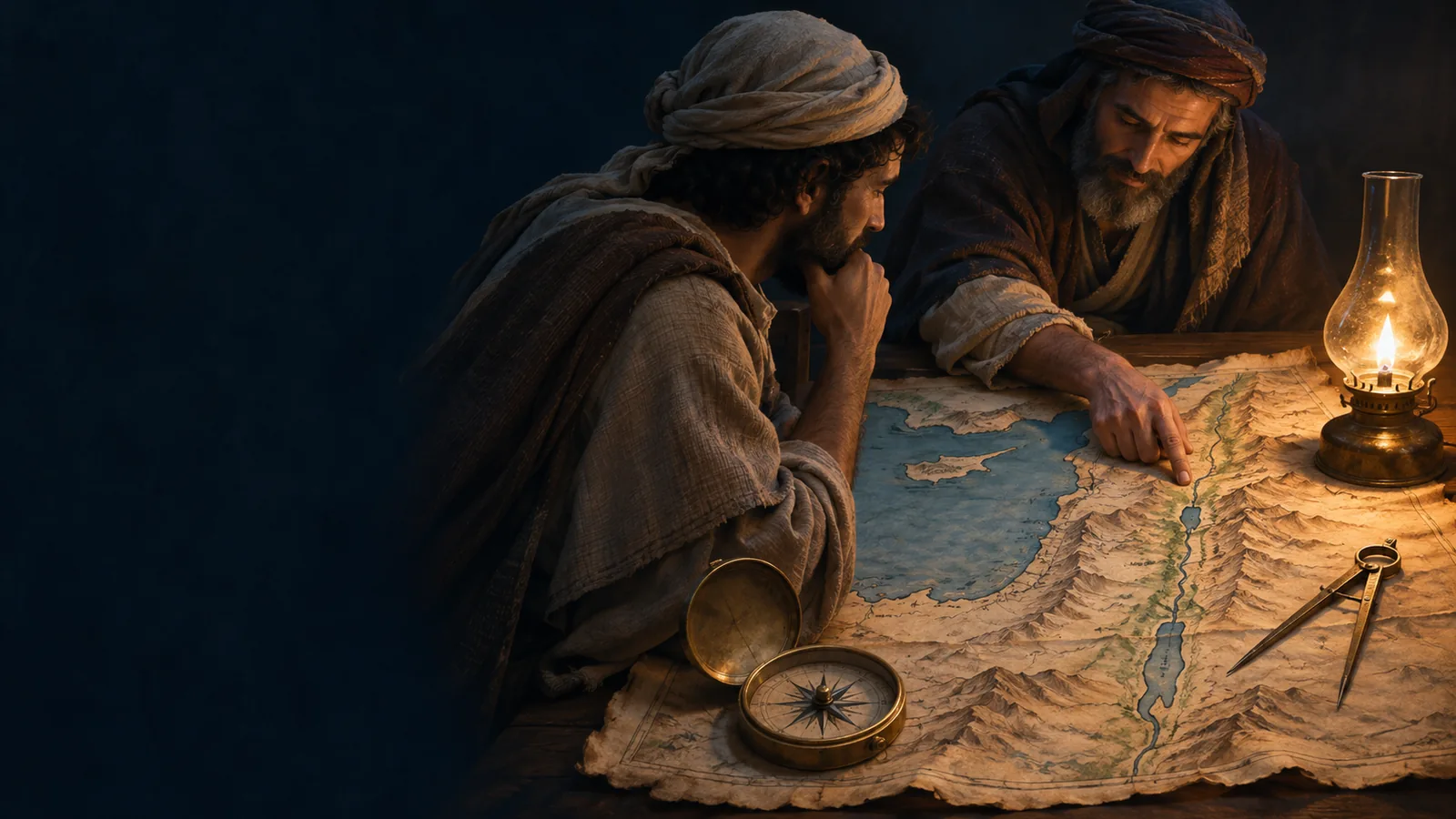
Biblical history and geography is the study of where and when the biblical story happens. It weighs the biblical text, inscriptions and annals from outside the Bible, and archaeology; describes the land, its regions, climate and roads; dates events against the surrounding empires; and grades how securely each biblical place can be identified, from secure to unknown.
Study v1.1, 1 November 2026
Places, routes, kingdoms and dates. Knowing where and when events happened sets each passage in its real setting.
Outside records give absolute dates for named kings from Ahab at Qarqar in 853 BCE and anchor Paul by Gallio's proconsulship; earlier dates, the exodus, Sinai and Eden remain unfixed.
Scholars divide over the exodus, the united monarchy and regnal systems; traditions divide over the historicity of Genesis to Joshua; modern names for the land divide by authority.
Reads the texts as reflecting the time in which they were written.
Julius Wellhausen set out the documentary hypothesis and read the patriarchal stories as reflecting the later periods in which they took shape. Albrecht Alt and Martin Noth held that semi-nomadic tribes settled peacefully in the highlands and fought the Canaanites only later, and Noth proposed a single Deuteronomistic History running from Deuteronomy to 2 Kings.
W. F. Albright made archaeological evidence decisive after 1920 and called the patriarchal narratives "essentially historical".
The "Baltimore School" model of Albright, G. E. Wright and John Bright had Israel enter Canaan by force about 1220 BCE; John Bimson criticized it for occupation gaps at Jericho, Ai and Gibeon and for circular method.
George E. Mendenhall started the "peasant revolt" model in 1962.
Norman K. Gottwald's The Tribes of Yahweh (1979) argued that Israel arose not from nomads, conquest or immigration but from an internal revolt within Canaanite society.
Holds, in Ronald Youngblood's summary, that the Old Testament was produced in the Persian or Hellenistic periods, so that its history reflects the writers' own time.
Its critics call it "minimalist", and several of the scholars so named reject the label. Thomas L. Thompson called "ancient Israel" a literary construct, and Keith W. Whitelam argues that scholarship obscured the history of ancient Palestine.
Treats the biblical text as a witness.
Iain W. Provan, V. Philips Long and Tremper Longman III let the Old Testament speak as a witness, often the only witness for the period before the monarchy, and K. A. Kitchen works back from the post-exilic period, the best attested outside the Bible, to argue that the earlier periods deserve a presumption of reliability.
Takes the Iron Age record as the test.
William G. Dever accepts an Israelite state from David onward; Israel Finkelstein's "low chronology" redates Philistine pottery, and he rejects a 10th-century united monarchy as the Bible describes it; Amihai Mazar takes a "middle-of-the-road" view in which the 9th-century framework of the Deuteronomistic History rests on reliable knowledge.
Begins from the sources.
Lester L. Grabbe moves from the biblical and non-biblical sources to analysis against the archaeology, treats the Bible as a secondary source and concludes that the united monarchy existed "not as the Bible pictures it". Mario Liverani traces the biblical texts to the times they were composed and places Israel in its ancient Near Eastern context.
The Chicago Statement on Biblical Inerrancy (1978) denies that inerrancy can be limited to spiritual, religious or redemptive themes to the exclusion of history and science, and the Chicago Statement on Biblical Hermeneutics (1982) affirms that Genesis 1 to 11 is factual.
Answers in Genesis, the strictest of these on the primeval history, holds that the creation days are six consecutive 24-hour days and that Noah's flood was worldwide.
In two Yale lecture courses, which speak for their lecturers rather than the field as a whole, Christine Hayes reads the primeval stories as etiological and calls the exodus "a highly embellished and theologically interpreted myth of origins for a nation", while holding that "most scholars would see David as a real person".
Dale B. Martin treats Jesus' baptism by John and his crucifixion on a charge of kingship as historically probable.
The Pontifical Biblical Commission's letter to Cardinal Suhard (1948) says of Genesis 1 to 11 that one can "neither deny nor affirm their historicity as a whole".
Dei Verbum (1965) says the Church "unhesitatingly asserts" the historical character of the four Gospels, and the Catechism of the Catholic Church holds that the account of the fall uses figurative language but affirms a primeval event.
Reads the Bible within the living Tradition of the Church: Thomas Hopko's catechetical The Orthodox Faith allows that scholars may help through archaeological, historical and literary study, but holds that academic work alone cannot produce the proper interpretation.
On the primeval history Orthodox readers draw on the Fathers, and Orthodox views on Genesis and evolution divide.
Maimonides lists the divine origin and the immutability of the Torah among his Thirteen Principles, and classes as a denier of the Torah one who says that even one verse is not from God, which underlies the principle of Torah min ha-shamayim.
Rabbi David Wolpe's Passover sermons of 2001 concluded that "the way the Bible describes the Exodus is not the way it happened, if it happened at all", while holding that "faith is independent of doubt"; a 2005 report states that he was reporting archaeologists' doubts rather than his own view.
The movement's Humash, Etz Hayim (2001), is reported to incorporate recent biblical scholarship and archaeological findings.
The Central Conference of American Rabbis' Pittsburgh Statement of Principles (1999) describes Torah as "God's ongoing revelation to our people", without affirming the historicity of particular narratives.
Writing at TheTorah.com, Ronald Hendel argues that "the Exodus is a cultural memory of a historical era that really happened", Egypt's rule over Canaan and its collapse, rather than the record of a single mass departure.
Richard Elliott Friedman argues in The Exodus (2017) that the exodus has a historical basis only if it refers to a small movement of Levites from Egypt to Canaan.
The eighth Article of Faith states: "We believe the Bible to be the word of God as far as it is translated correctly; we also believe the Book of Mormon to be the word of God."
Fundamental Belief 6 states that "in a recent six-day creation the Lord made the heavens and the earth", and Fundamental Belief 1 calls Scripture "the trustworthy record of God's acts in history".
Date the destruction of Jerusalem to 607 BCE, counting a literal 70 years back from a return they place in 537 BCE, while acknowledging that 586 or 587 BCE is generally accepted.
The Qur'an, 17:1, speaks of God taking His servant by night from the Sacred Mosque to the Farthest Mosque, and in 5:21 Moses tells his people Enter the Holy Land which Allah has destined for you.
UNESCO describes the Al-Ibrahimi Mosque/Tomb of the Patriarchs in Hebron as a pilgrimage site for the three monotheistic religions.
Hold that God chose Mount Gerizim near Shechem, where Jews hold that God chose Mount Zion in Jerusalem, and accept only the Pentateuch as scripture.
The Gerizim temple was destroyed by John Hyrcanus in the second century BCE.
Eusebius of Caesarea probably completes the Onomasticon, an alphabetical gazetteer of biblical place names that locates places by distances in Roman miles from fixed cities. Jerome translates it into Latin around 390, correcting errors and adding fourth-century churches.54
Edward Robinson identifies Khirbet Seilun with Shiloh.59
Martin Noth explains pre-state Israel by analogy with the Greek amphictyony, a league of twelve tribes around a central sanctuary, and then proposes a single Deuteronomistic History, a historical work of the 6th century BCE.4
Thomas L. Thompson's The Historicity of the Patriarchal Narratives and John Van Seters' Abraham in History and Tradition end the view, common in America, that the patriarchal period was historically reliable.70
Gather the three kinds of evidence: the biblical text, epigraphic sources such as inscriptions, and the material record recovered by archaeology75.
Read each outside text for what it is: royal monuments and annals were written to celebrate a king, and their own editors warn that victory claims and figures in them are royal propaganda, while working documents such as letters, dockets, contracts and petitions carry incidental names and dates767778.
Separate relative dates, counted from another event inside the text, as 1 Kings 6:1 counts from the exodus, from absolute dates, which are reached only when such a chain is tied to an anchor outside the text79.
Tie the chain to fixed points: the Assyrian eponym lists record a solar eclipse placed on 15 June 763 BCE, and through them Ahab at Qarqar in 853 BCE and Jehu's tribute in 841 BCE are dated8081827683.
Convert the regnal numbers only after naming the choices behind them: accession or non-accession reckoning, the month the regnal year began, how each kingdom counted the other's kings, coregencies, and whether methods changed over time68.
Name the system a date depends on, since the systems differ: the division of the kingdom is 931/930 BCE for Thiele, Galil and Kitchen and 922 BCE for Albright and Bright8485.
For the Hellenistic and Roman periods, convert the ancient reckonings by the Seleucid era, Olympiads, Roman consuls, regnal years and Jewish months, noting that one Seleucid year can convert to two BCE years868788.
Keep the place apart from the events placed there: a site can be secure while the date or nature of what happened there stays disputed, as at Jericho and Shiloh8990.
Keep the late antique placements of Eusebius and Egeria apart from modern identifications, and check them against archaeological survey, the Roman itineraries and the Madaba Map5455.
Date every figure that changes over time, such as the level of the Dead Sea, which fell from 389 m below sea level in 1896 to about 430 m by the mid-2010s9192.
The works below shaped the field and are cited in this study, from the earliest to the most recent. Hover over a book, or select it, to see its author and the sources behind it.
Listed because this study draws on their published work; no association with or endorsement of Numa Verse is implied. Suggest a correction.
The words that carry the most weight in this field, each defined from the sources of this study. Turn a card over to read its definition.
The Merneptah stele, found by Flinders Petrie in 1896 in Merneptah's mortuary temple at Thebes, whose closing hymn states "Israel is laid waste, his seed is no more"13313495. It is dated by the reign assigned to Merneptah to about 1209 to 1207 BCE, and it writes Israel with the signs for a people, not a city-state or land9394.
Its location is unknown. Jebel Musa in southern Sinai has been the Christian Sinai since the fourth century CE, though the evidence for it dates no earlier than the Byzantine period13556. At least seven other candidates are argued, among them Har Karkom in the Negev and sites in northwest Arabia136137.
The execution under Pontius Pilate in the reign of Tiberius is secure: Tacitus and the Gospels agree on the governor and the reign107138. The exact date depends on the calendar reconstruction and the Gospel chronology chosen, and Guillermo Gonzalez gives 7 April 30 CE and 3 April 33 CE as the two dates most New Testament chronologists have settled on139.
It cannot be fixed on a map from the text: of the four rivers of Genesis 2:10 to 14, only the Tigris and Euphrates match known rivers140. Proposals run from the marshes of southern Iraq to the Persian Gulf, and Gordon Wenham, G. K. Beale and Terje Stordalen read Eden as a sanctuary141142143144145146.
Reviewed and approved by Duane Herholdt, BA (Theology), Chief Executive Officer, Numa Verse
Study version: v1.1, 1 November 2026 (theology map v1.27)
Last reviewed: 7 November 2026
