
Why it matters for reading Scripture
Jude quotes 1 Enoch, and the Ethiopian Orthodox Church holds it as Scripture. It belongs to the writings of the Second Temple period.
Biblical studiesWhat does the text say?
The Book of Enoch is not one book but a family of Jewish and Christian writings that grew out of six verses in Genesis. 1 Enoch is an anthology of five works composed between about the 3rd century BCE and the 1st century CE, four of them attested in Aramaic at Qumran and the whole complete only in Ge'ez.
Study v1.1, 9 October 2026
Jude quotes 1 Enoch, and the Ethiopian Orthodox Church holds it as Scripture. It belongs to the writings of the Second Temple period.
1 Enoch was never removed from the Bible: it was never in the Hebrew Bible or any Greek or Latin canon list, but it is quoted in Jude and survived whole in Ethiopia.
The Ethiopian and Eritrean churches read it as Scripture within a canon traditionally counted as 81 books; most other churches do not; scholars dispute the date of the Parables.
Hold Enoch (Henok) and Jubilees as scripture within a canon traditionally called "the 81 books".
The count is traditional rather than a single fixed table of contents, and R. W. Cowley distinguished a narrower canon, used in church prayers and the large printed Bibles, from a broader one that adds church-order and historical books. A church-affiliated site says the book exists entire only in Ge'ez, shapes Ethiopian angelology and eschatology, and that the Ge'ez text retains authority over modern Amharic. Ethiopia received Enoch with its Greek scriptures while the book was still widely read, and was distant from the Mediterranean centers that later narrowed the canon.
The Jews of Ethiopia preserved and used Enoch alongside Jubilees.
How it ranks within their own scriptural tradition is to be described in that tradition's own terms.
Never treated Enoch as scripture.
Genesis Rabbah 26:5 records Rabbi Shimon bar Yohai reading the "sons of God" as sons of judges and cursing anyone who calls them sons of God, one voice preserved in a later compilation rather than a decision about the book. Annette Yoshiko Reed argues that the rabbis set aside Enochic literature after the Bar Kokhba revolt, and later Hekhalot tradition took Enoch up again as Metatron.
Does not accept Enoch, because it is not in the Septuagint.
As the Coptic church is Ethiopia's historic mother church, the Ethiopian position is a distinct local tradition rather than a preserved "original" canon.
Do not treat 1 Enoch as scripture, though most value it as background.
Catholic, evangelical and other writers argue that quoting a source does not canonize it, comparing Paul's quotations of Greek poets. One Eastern Orthodox writer places it among books "preserved by and for the faithful" but not read liturgically as scripture.
Have their own revealed Enoch material in Moses 6 to 7, which is separate from 1 Enoch; whether Joseph Smith knew Laurence's translation is debated.
Diverge, from appreciative scholarship to dismissal; the sources record no official statement.
Keep apart three levels: what a manuscript reads, what scholars reconstruct, and interpretation; present no interpretation as absolute and give each church's view in its own voice582650.
Begin from the Aramaic fragments of Qumran, which secure the original for four of the five books, and treat the complete Ethiopic as a translation of a translation4935.
Where the Aramaic is poor or absent, as for the Parables and the Astronomical Book, let the Ethiopic decide59.
Compare the witnesses at each disputed verse and report where they differ: at 7:2 Charles's Ethiopic gives 3,000 ells and the Panopolitanus Greek 3,000 cubits, Syncellus gives no height, Laurence printed 300 and the Aramaic number is restored rather than read5354366061.
Date the copies and the composition separately: handwriting and radiocarbon date the copies, and composition is earlier than the copies206263.
State numbers, such as dates, heights and manuscript counts, only with their source, and attribute counts that conflict643835.
Use historical allusions in the text with caution, since such scenes can be stock imagery65.
Check every quoted line against the Hermeneia translation, the standard modern rendering, and name exactly which Charles text is used584666.
The works below shaped the field and are cited in this study, from the earliest to the most recent. Hover over a book, or select it, to see its author and the sources behind it.
Listed because this study draws on their published work; no association with or endorsement of Numa Verse is implied. Suggest a correction.
The words that carry the most weight in this field, each defined from the sources of this study. Turn a card over to read its definition.
No. 1 Enoch was never part of the Hebrew Bible, the great Septuagint codices or any Greek or Latin church canon list10488. It was widely read, quoted in Jude and treated as scripture by some early Christians, Tertullian above all, before it was slowly marginalized between about 300 and 500 CE2730. No council removed it: the canon list of the Council of Laodicea, of disputed authenticity, does not include it, and the Council of Nicaea in 325 made no decision about the biblical canon105106107.
Jude 14 to 15 is the one direct, acknowledged quotation: it introduces 1 Enoch 1:9 with prophesied and names Enoch, the seventh from Adam2728. Jude 6 and 2 Peter 2:4 draw on the tradition of imprisoned Watchers; further parallels are argued but not proven, and analogy does not prove dependence28108. Traditions differ on what the quotation means: Tertullian took Jude as endorsing Enoch, while Augustine held that the writings under Enoch's name were not genuinely his30109.
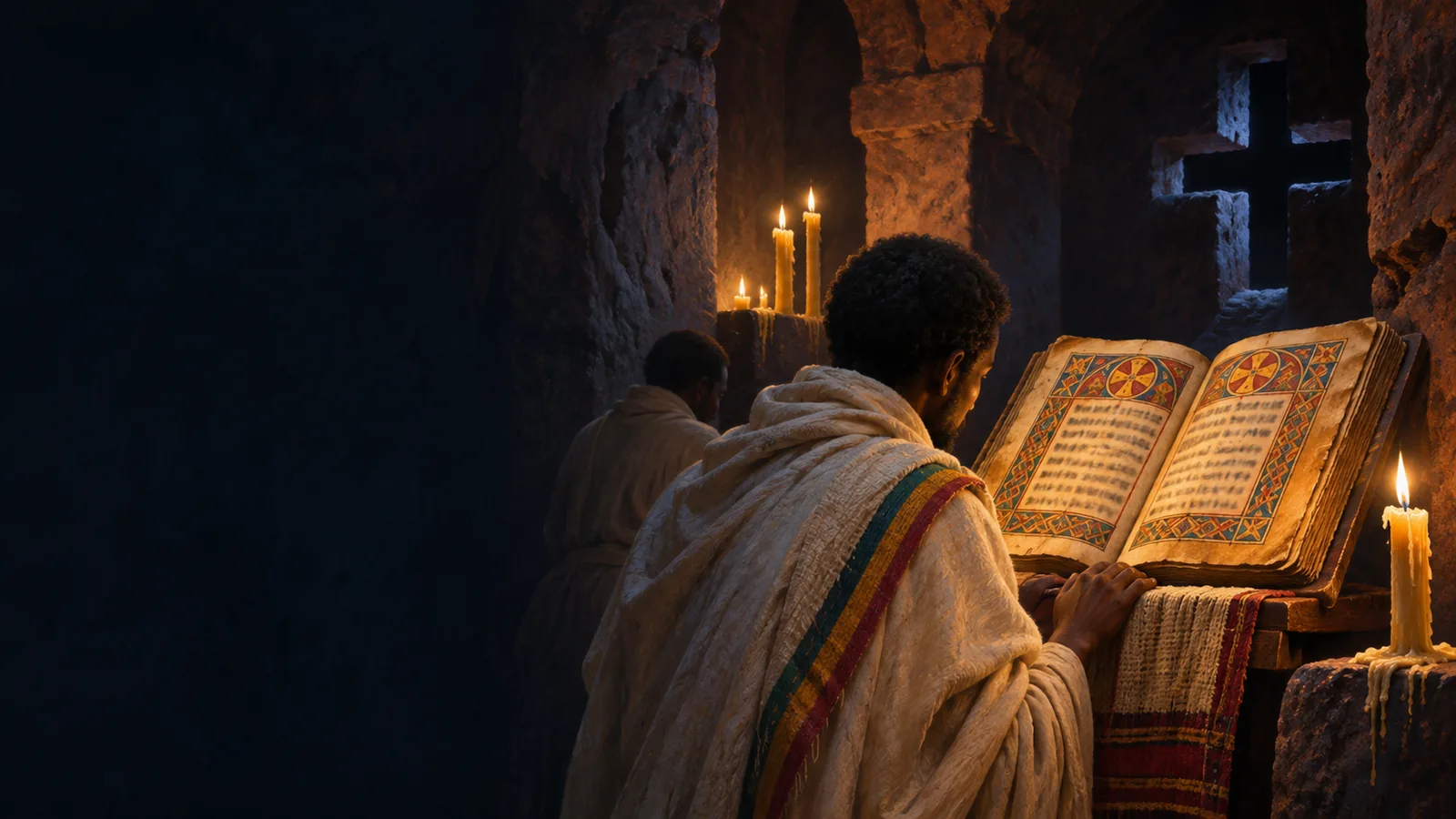
Ethiopia received Enoch with its Greek scriptures while the book was still widely read, translated it into Ge'ez, used it liturgically and theologically, and was distant from the Mediterranean centers that later narrowed the canon45. The Coptic Orthodox Church, Ethiopia's historic mother church, does not accept it, so the Ethiopian position is a distinct local tradition rather than a preserved "original" canon10.
Genesis 6:1 to 4 mentions them briefly and ambiguously and does not tell the Watchers story; in Genesis 6:4 and 1 Enoch the Nephilim are the offspring, not the angels91. Jews and Christians have read the "sons of God" as angels, as the line of Seth or as human rulers, and 1 Enoch developed the angelic reading into the story of the Watchers and their giant offspring56790.
Reviewed and approved by Duane Herholdt, BA (Theology), Chief Executive Officer, Numa Verse
Study version: v1.1, 9 October 2026 (theology map v1.27)
Last reviewed: 7 November 2026
