
Numa Verse

Practical theologyHow is it lived and shared?

Homiletics

What is homiletics?

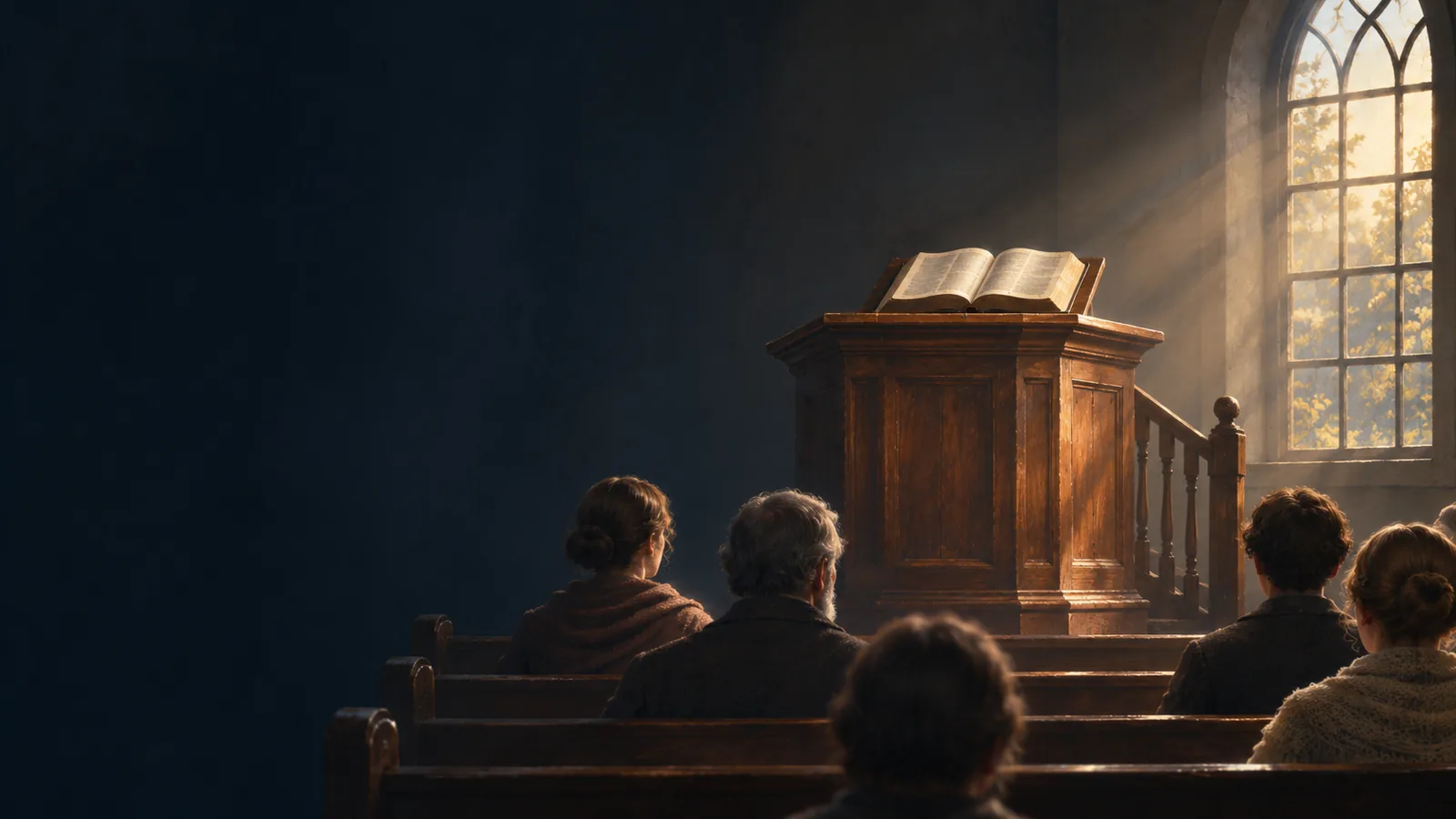
Homiletics is the branch of theology that studies preaching: its theology, the composition of sermons and homilies, and their delivery to a congregation. Its name comes from the Greek homilia, from a verb meaning to converse. It has argued from the start about its relation to classical rhetoric, and since the nineteenth century it has been taught within practical theology.

  • 116Sources
  • 24Traditions
  • 16Dated entries
  • 15Minutes

Study v1.0, 12 October 2026

At a glance

Why it matters for reading Scripture

The craft of preaching: turning a passage into one clear message.

What the study found

Homiletics studies the theology, composition and delivery of preaching; its oldest question is eloquence and truth, and its focus has moved from the speaker to the listener.

Where traditions divide

Rhetorical, kerygmatic, New Homiletic and expository schools differ, and traditions divide over who may preach.

How the traditions compare

  • Roman Catholic Church

    Canon 767 of the 1983 Code of Canon Law calls the homily, which is part of the liturgy and reserved to a priest or deacon, preeminent among the forms of preaching, and requires it at Sunday and holy-day Masses with a congregation unless there is a grave cause; canon 766 allows lay people to preach in a church where necessity or advantage requires it.

    The Homiletic Directory (2014) asks for only one homily at Mass, expressing the faith of the Church rather than the preacher's own story. Mary Catherine Hilkert's Naming Grace (1997) grounds preaching in the sacramental imagination, the naming of grace already present in human experience.

    Sources1–3
  • Eastern Orthodox Church

    Orthodox writers describe preaching as an inseparable part of the liturgy of the Word that can never be dispensed with, originally the bishop's gift exercised from the cathedra and today exercised by priests as bearers of the tradition.

    The homily follows the Gospel and belongs to the ranking celebrant, who may delegate it to a priest or deacon but not to a layperson; Chrysostom's Paschal homily is read every Easter. In Romania homiletics is a compulsory course in Orthodox pastoral theology, taught at Babeș-Bolyai University to form the skills of the preacher.

    Sources4–6
  • Oriental Orthodox churches

    Preaching takes the form of the homily within the liturgy and of teaching meetings, given by the clergy, as in the Coptic, Armenian and Syriac churches.

    A 2023 Fordham doctorate examined Coptic preaching in Lent as catechesis, St Nersess Seminary runs a preaching program for Armenian clergy with a collection of patristic homilies called Karoz, and the Syriac tradition took excerpts of Jacob of Serugh's verse homilies into its liturgy.

    Sources7–9
  • Lutheran

    The Augsburg Confession holds that the ministry of teaching the gospel and administering the sacraments was instituted so that faith may be obtained, and that through the Word and sacraments the Spirit is given; called ministers preach.

    C. F. W. Walther's lectures of 1884 and 1885, published as The Proper Distinction between Law and Gospel, are summarized in the rule: preach the law, preach the gospel, do not mix them.

    Sources10–11
  • Reformed

    The Second Helvetic Confession, written by Heinrich Bullinger and published in 1566, heads its first chapter with the claim that the preaching of the Word of God is the Word of God.

    The Westminster Larger Catechism makes preaching an effectual means of grace, to be done by those duly approved and called, plainly, faithfully and wisely, with hearers who examine what they hear by the Scriptures.

    Sources12–14
  • Anglican

    The Church of England's Books of Homilies (1547 and 1571), containing godly and wholesome doctrine, were written to be read aloud in parishes where preaching ability was lacking, and Article 35 commends them.

    Gerald Bray notes that the Church of England is the only Reformed body to include sermons among its statements of faith.

    Sources15–16
  • Methodist

    John Wesley's 44 sermons became, with his notes on the New Testament, the standard doctrine of Methodism, and his plain style reached plain people through lay preachers; ordained and lay preachers preach in churches and in the fields.

    Wesley preached in the open air near Bristol on 2 April 1739 to about three thousand people, a practice he first found strange.

    Sources17–18
  • Baptist and evangelical

    Preaching is the exposition of one biblical idea: the evangelical expository school takes its definition from Haddon Robinson, whose Biblical Preaching (1980) centers every sermon on one big idea.

    In the Southern Baptist Convention the Baptist Faith and Message (2000) limits the office of pastor to men.

    Sources19–21
  • Black church

    Preaching is whole-person proclamation that ends in celebration, with call and response, and Henry Mitchell held that preaching without celebration is a denial of the good news in any culture.

    Cleophus LaRue described Black congregations as giving continual feedback during sermons, and preachers are formed by the congregation as much as by the seminary. Celebration is one strand of a varied tradition: Prathia Hall stands for its prophetic and womanist preaching, and Teresa L. Fry Brown's Weary Throats and New Songs (2003) recovers the preaching of Black women.

    Sources22–25
  • Pentecostal and charismatic

    Marius Nel describes Pentecostal preaching as re-enactment of the text aimed at transformation, with the Spirit's anointing as its precondition, testimonies as illustration and the freedom to stop and pray for healing.

    He names manipulation, emotionalism and prosperity teaching as its risks.

    Sources26
  • Anabaptist

    An Anabaptist collection of 2003 treats preaching as a conversation among pulpit, pew and Bible, with preachers working with the congregation.

    Sources27
  • Seventh-day Adventist

    An Adventist account frames all preaching by the three angels' messages of Revelation 14 and places Christ at the center of every sermon; pastors and elders preach.

    Sources28
  • Rhetorical or traditional school

    Preaching teaches, delights and persuades through well-built argument.

    Augustine, following Cicero, matched a subdued, a temperate and a majestic style to these three aims, and John A. Broadus's textbook of 1870 opens with a section on the relation of homiletics to rhetoric.

    Sources29–30
  • Kerygmatic school

    Preaching is one of the three forms of the Word of God, and the church exists in and through proclamation.

    The school stems from Karl Barth's homiletics seminar at Bonn in 1932 and 1933, and Barth treated preaching as material that dogmatics must test.

    Sources31–32
  • New Homiletic

    A group of North American homileticians who, from the late 1950s, moved attention from the content of the sermon to its form and to the experience of the hearer, with H. Grady Davis's Design for Preaching (1958) as forerunner.

    Fred Craddock's As One Without Authority (1971) held that the listener completes the sermon; Eugene Lowry's The Homiletical Plot (1980) shaped it as a plot moving through tension to resolution; David Buttrick's Homiletic: Moves and Structures (1987) built a phenomenology of how sermons form in a congregation's shared consciousness. It was soon questioned from within: William Brosend records Thomas Long's later judgment that narrative preaching was taking on water.

    Sources33–37
  • Celebrative school

    Preaching addresses the whole person and ends in celebration, after Henry Mitchell's Black Preaching (1970) and Frank A. Thomas's They Like to Never Quit Praisin' God (1997).

    Sources38–39
  • Expository school

    One biblical concept, derived by exegesis and applied, in the work of Haddon Robinson (1980), John Stott (1982) and Bryan Chapell (1994).

    Stott described preaching as bridge-building across the broad and deep divide between the biblical and modern worlds, and Chapell asked the preacher to locate the fallen condition each text addresses and the grace that answers it.

    Sources2040–43
  • Witness school

    The preacher is a witness who sees before speaking.

    Thomas Long's model, first published in 1989, sought a middle way between proclaiming and narrating.

    Sources44–45
  • Conversational and collaborative school

    Preaching is a shared conversation in a roundtable church: John McClure (1995) and Lucy Atkinson Rose (1997) sought to share the preacher's authority with the congregation.

    Sources46–47
  • Contextual school

    The preacher exegetes the congregation as well as the text, and Leonora Tubbs Tisdale's Preaching as Local Theology and Folk Art (1996) gives a method for analyzing a congregation as carefully as a biblical text.

    Sources48
  • Prophetic school

    Preaching stands at the intersection of human suffering and God's grace and challenges the status quo, with Tisdale and Walter Brueggemann among its key voices.

    Sources49–50
  • Liturgical and sacramental school

    The homily is part of the liturgical act, as Sacrosanctum Concilium and the Homiletic Directory set out.

    The Second Vatican Council held that the homily should not be omitted at Sunday Masses without a serious reason.

    Sources251
  • Postcolonial and intercultural school

    Preaching is never neutral, and the pulpit is treated as a decolonized space.

    Boston University's 2014 consultation on preaching and postcolonial theology brought together Kwok Pui-lan, David Schnasa Jacobsen, Pablo Jiménez, Sarah Travis and others, and Travis argues that colonizing discourses keep a fixed boundary between center and margins.

    Sources52–53
  • Empirical school

    It studies what listeners actually hear and how sermons function.

    In Germany Ernst Lange initiated the empirical turn, preferring the communication of the gospel to proclamation as the name for preaching, and Heidelberg today has a sermon research center and an empirical homiletics project. In North America the Listening to Listeners to Sermons project interviewed 263 people in 28 congregations and found that listeners value honesty, faithfulness and spiritual wisdom above eloquence.

    Sources54–56

How the field developed

  1. Second Temple
    5th century BC onwards

    The Torah is read aloud and explained in the vernacular, a practice associated with Ezra (Nehemiah 8). From it comes the derashah, exposition following the reading of Scripture in worship.5758

  2. Early church
    2nd century

    Justin Martyr's First Apology 67 records that after the Sunday readings the presiding bishop preaches. The so-called Second Letter of Clement is the oldest surviving Christian homily.59

  3. Early church
    3rd century

    Origen, called the father of the homily, is credited with first separating the homily from the formal discourse. He preached almost every day; 21 of his homilies survive in Greek and nearly two hundred in the Latin translations of Rufinus and Jerome.6059

  4. Late antiquity
    Late 4th and early 5th centuries

    Augustine's De doctrina christiana, Book IV, regarded as the first Christian manual on preaching, follows Cicero in setting the three aims of the Christian speaker, to teach, to delight and to persuade, with a style for each.6129

  5. Late antiquity
    590

    Gregory the Great's Pastoral Rule, written at the start of his pontificate, teaches that one exhortation does not suit all hearers. For centuries it was the textbook of bishops.6263

  6. Medieval
    12th to 15th centuries

    The thematic or university sermon, built on a short theme from Scripture and divided and subdivided, is taught through technical manuals called artes praedicandi, of which about 230 survive. Alan of Lille defines preaching as plain and public instruction in morals and faith.6465

  7. Reformation
    1 January 1519

    Huldrych Zwingli begins preaching through the Gospel of Matthew at the Grossmünster in Zurich, and continuous exposition of Scripture becomes the Reformation norm.66

  8. Reformation
    17 June 1546

    The fifth session of the Council of Trent requires bishops to preach in person and parish priests to preach at least on Sundays and solemn feasts, through competent substitutes where lawfully hindered.6768

  9. Reformation
    1553

    Andreas Hyperius's De formandis concionibus sacris appears at Marburg; it has been called the first complete work on homiletics and the basis of Protestant homiletics.6970

  10. Modern
    1811 and 1830

    Friedrich Schleiermacher's Brief Outline of the study of theology gives practical theology systematic form, calls it the crown of theological study, and derives homiletics, liturgics, catechetics, missions and pastoral care from the life of the congregation.71

  11. Modern
    1870

    John A. Broadus's A Treatise on the Preparation and Delivery of Sermons appears, written as a textbook for classes; in its 1944 revision it is still among the five most used American homiletics texts a century later.3072

  12. Modern
    1932 to 1933

    Karl Barth's homiletics seminar at Bonn, published in English as Homiletics in 1991, grounds preaching in a theology of the Word and gives rise to the kerygmatic school.32

  13. Modern
    1963 and 1965

    The Second Vatican Council, in Sacrosanctum Concilium and Dei Verbum, restores the homily as part of the liturgy itself.5173

  14. Modern
    1970 and 1971

    Henry Mitchell's Black Preaching sets out celebration, and Fred Craddock's As One Without Authority marks the inductive turn, in which the listener completes the sermon.3834

  15. Modern
    1993

    Societas Homiletica is formally founded at Oslo as an international society, with origins at Heidelberg in 1986.74

  16. Modern
    2013 and 2014

    Pope Francis's Evangelii Gaudium and the Homiletic Directory of the Congregation for Divine Worship bring a Catholic renewal of the homily.752

How to study homiletics

The questions it asks

  • What is preaching, who may preach, where does it belong in worship, and what is it meant to do?
  • Is homiletics a branch of rhetoric or a theological discipline of its own?2961
  • How does eloquence relate to truth?76
  • How does a preacher move from a text of Scripture to a sermon heard by a congregation?
  • Should preaching follow a lectionary or run continuously through a book?7766
  • What do listeners actually hear, and how do sermons function?56

Its method

Start
  1. Read the text prayerfully, with meditation, prayer and contemplation; the Homiletic Directory recommends lectio divina2.

  2. Study the passage in its context through historical, grammatical and literary exegesis19.

  3. Exegete the congregation as well, listening for its operative theology and culture48.

  4. Distill one governing idea or focus, such as Robinson's big idea or Chapell's Fallen Condition Focus2043.

  5. Relate the trouble and the grace in the text to the trouble and the grace in the world, as in Paul Scott Wilson's four pages78.

  6. Choose a form and design: deductive, inductive, narrative or a sequence of moves343536.

  7. Deliver the sermon as oral performance, with or without a manuscript, which Cleophus LaRue calls an arrested performance23.

  8. Listen to the hearers and evaluate the sermon56.

What to read

Its primary witnesses

  • The homilies of Origen, recorded by stenographers, of which 21 survive in Greek and nearly two hundred in Latin translation6059.
  • John Chrysostom's series, including 67 homilies on Genesis, 90 on Matthew and 88 on John, and his On the Priesthood7980.
  • Augustine's De doctrina christiana, Book IV, and Gregory the Great's Pastoral Rule2963.
  • The Syriac verse homilies of Ephrem, and those of Jacob of Serugh, who composed some 763, of which at least 380 survive819.
  • The medieval artes praedicandi, of which about 230 survive64.
  • Martin Luther's sermons, about 2,300 of some four thousand surviving, and his postils82.
  • John Calvin's sermons, recorded from 1549 by the refugee stenographer Denis Raguenier83.
  • The Books of Homilies (1547 and 1571) and John Wesley's 44 sermons1517.
  • The confessions on preaching: the Augsburg Confession, the Second Helvetic Confession and the Westminster Larger Catechism101214.
  • Catholic church documents: Sacrosanctum Concilium, the 1983 Code of Canon Law and the Homiletic Directory5112.
  • Recorded sermons and listeners: Pew's analysis of 49,719 online sermons and the interviews of the Listening to Listeners to Sermons project8456.

Standard reference works

  • John A. Broadus, A Treatise on the Preparation and Delivery of Sermons (1870; revised editions)30.
  • Karl Barth, Homiletics (Westminster John Knox, 1991)32.
  • Fred B. Craddock, As One Without Authority (1971) and Preaching (1985)34.
  • Eugene L. Lowry, The Homiletical Plot (expanded edition, 2000), and David Buttrick, Homiletic: Moves and Structures (Fortress, 1987)3536.
  • Thomas G. Long, The Witness of Preaching (third edition, 2016), and Paul Scott Wilson, The Four Pages of the Sermon (revised and updated, 2018)4578.
  • Haddon W. Robinson, Biblical Preaching (1980; third edition), and Bryan Chapell, Christ-Centered Preaching (1994; third edition)2041.
  • Leonora Tubbs Tisdale, Preaching as Local Theology and Folk Art (Fortress, 1996)48.
  • Henry H. Mitchell, Black Preaching (1970), and Cleophus J. LaRue, The Heart of Black Preaching (2000)3885.
  • Wilfried Engemann, Einführung in die Homiletik (third edition, 2020), the German textbook of record86.
  • The histories of O. C. Edwards Jr, A History of Preaching (2004), and Hughes Oliphant Old, The Reading and Preaching of the Scriptures (from 1998)8788.
  • Mary Catherine Hilkert, Naming Grace (1997), and A Handbook for Catholic Preaching, edited by Edward Foley (2016)389.
  • The Homiletic Directory (2014) and the US Catholic bishops' Fulfilled in Your Hearing (1982) and Preaching the Mystery of Faith (2012)29091.
  • Omiletica, edited by Vasile Gordon (Bucharest, 2015), a Romanian Orthodox manual6.
  • The journals Homiletic, of the Academy of Homiletics, and the International Journal of Homiletics, of Societas Homiletica9293.

Scholarship referenced in this study

The works below shaped the field and are cited in this study, from the earliest to the most recent. Hover over a book, or select it, to see its author and the sources behind it.

  • 1535EcclesiastesDesiderius ErasmusEcclesiastes (1535)Desiderius Erasmus (1469 to 1536)Sources94–95
  • 1553De formandis concionibus sacrisAndreas HyperiusDe formandis concionibus sacris (1553)Andreas Hyperius (1511 to 1 February 1564)Sources7096
  • 1877Lectures on PreachingPhillips BrooksLectures on Preaching (1877)Phillips Brooks (1835 to 1893)Sources97
  • 1932 to 1933HomileticsKarl BarthHomiletics (1932 to 1933)Karl Barth (1886 to 1968)Sources32
  • 1970Black PreachingHenry H. MitchellBlack Preaching (1970)Henry H. Mitchell (1919 to 15 January 2022)Sources98–99
  • 1971As One Without AuthorityFred B. CraddockAs One Without Authority (1971)Fred B. Craddock (1928 to 2015)Sources100–101
  • 1980Biblical PreachingHaddon W. RobinsonBiblical Preaching (1980)Haddon W. Robinson (1931 to 2017)Sources20102
  • 1982I Believe in PreachingJohn R. W. StottI Believe in Preaching (1982)John R. W. Stott (passed away 27 July 2011, aged 90)Sources42103
  • 1987Homiletic: Moves and StructuresDavid G. ButtrickHomiletic: Moves and Structures (1987)David G. Buttrick (passed away 22 April 2017, aged 89)Sources104
  • 1989The Witness of PreachingThomas G. LongThe Witness of Preaching (1989)Thomas G. LongSources105
  • 1996Preaching as Local Theology and Folk ArtLeonora Tubbs TisdalePreaching as Local Theology and Folk Art (1996)Leonora Tubbs TisdaleSources106
  • 1997Naming GraceMary Catherine HilkertNaming Grace (1997)Mary Catherine HilkertSources107

Listed because this study draws on their published work; no association with or endorsement of Numa Verse is implied. Suggest a correction.

Key terms

The words that carry the most weight in this field, each defined from the sources of this study. Turn a card over to read its definition.

The branch of theology that studies preaching: its theology, the composition of sermons and homilies, and their delivery to a congregation61.

Commentary on a passage of Scripture without formal introduction, division or conclusion, explaining its literal sense and drawing out its spiritual sense; the word goes back to homilein, to converse with a person59.

A formal discourse, classically built by the analytic method of divisions and subdivisions61.

The public proclamation of the gospel to those outside the church, distinguished by C. H. Dodd from didache108.

Teaching, mostly ethical instruction108.

Exhortation; the word of exhortation of Hebrews 13:22, treated by Attridge as the technical name of the homily form108109.

The Jewish homily or sermon, generally preached in the synagogue57.

A sermon that communicates the concept of a passage, derived from historical, grammatical and literary study19.

The medieval technical manuals that taught the thematic sermon, built on a short theme from Scripture and divided and subdivided; about 230 survive64.

The cycle of readings that much preaching follows; the Roman Order of Readings runs a three-year Sunday cycle and a two-year weekday cycle77.

Questions people ask

The difference is one of form and setting rather than of value. Origen is credited with first separating the formal discourse from the homily, a familiar exposition, and the 1910 Catholic Encyclopedia describes the higher homily as differing from the set sermon only in lacking an introduction and peroration59. Protestant usage tends to say sermon for every kind; Catholic and Orthodox usage reserves homily for preaching within the liturgy, which Pope Francis described as a distinctive genre2.

The traditions divide on it. In Catholic canon law the homily is reserved to a priest or deacon, though lay people may preach in a church where necessity or advantage requires it1. In the Southern Baptist Convention the Baptist Faith and Message (2000) limits the office of pastor to men, and on 14 June 2023 the Convention upheld the expulsion of two churches over women pastors21. Most mainline Protestant churches ordain women, and a growing literature studies women's and womanist preaching110111112.

In a Barna survey of 278 senior pastors in January 2024, 12% said they were comfortable using AI to write sermons, while 43% saw merit in using it for preparation and research113. Barna's study of 442 Protestant pastors, published on 15 June 2026, found that 87% use AI in some way and 24% report writing or editing sermons with its help; Barna notes that the two figures measure different things, comfort in 2024 and practice in 2026114. The Southern Baptist Ethics and Religious Liberty Commission's guide of 25 September 2025 holds that AI can assist preparation but should never replace the preacher's calling115.

Pew's analysis of 49,719 online sermons in 2019 found a median length of 37 minutes, ranging from 14 minutes in Catholic churches to 54 minutes in historically Black Protestant churches84. Catholic norms ask for brevity752. Lifeway Research reported on 6 October 2026 that the share of Protestant pastors preaching under 40 minutes fell from 85% in 2019 to 80% in 2025, and the share preaching an hour or more rose from 2% to 6%116.

The question has never closed. The 1910 Catholic Encyclopedia records both the view that homiletics is the branch of rhetoric dealing with sermons and the opposing view that it is independent in origin, matter and purpose61. Augustine's own answer, that a Christian teacher may lawfully use the art of rhetoric but that wisdom matters more than eloquence, remains the classic settlement76.

Contribute to homiletics

Register to contribute

  1. 1Code of Canon Law, Book III, canons 756 to 780 (The Holy See)https://www.vatican.va/archive/cod-iuris-canonici/eng/documents/cic_lib3-cann756-780_en.html (opens in a new tab)
  2. 2Homiletic Directory, Congregation for Divine Worship and the Discipline of the Sacraments (The Holy See)https://www.vatican.va/roman_curia/congregations/ccdds/documents/rc_con_ccdds_doc_20140629_direttorio-omiletico_en.html (opens in a new tab)
  3. 3Review of Mary Catherine Hilkert, Naming Grace (Horizons 25.2, 1998, Cambridge Core)https://www.cambridge.org/core/journals/horizons/article/abs/naming-grace-preaching-and-the-sacramental-imagination-by-mary-catherine-hilkert-new-york-continuum-1997-252-pages-2995/2FF04FECC0753ECF828B7942518C7160 (opens in a new tab)
  4. 4Understanding the Divine Liturgy: The Homily, M. Najim and T. L. Frazier (oodegr.com)https://oodegr.com/english/biblia/Najim_Frazier_Liturgy/chapter%20III.9.htm (opens in a new tab)
  5. 5Preaching (OrthodoxWiki)https://orthodoxwiki.org/Preaching (opens in a new tab)
  6. 6Omiletica I (OLR7776), 2024 to 2025, course sheet (Babeș-Bolyai University, Faculty of Orthodox Theology)https://ot.ubbcluj.ro/sites/default/files/pages/217/VidicanManci_Omiletica%CC%86_I_2024-2025.pdf (opens in a new tab)
  7. 7D. Habib, In Your Light, We See Light: Religious Education Through the Homily in the Coptic Orthodox Church, PhD, 2023 (Fordham University)https://research.library.fordham.edu/dissertations/AAI29390550 (opens in a new tab)
  8. 8New Karoz for Clergy (St Nersess Armenian Seminary)https://www.online.stnersess.edu/press/new-karoz-for-clergy (opens in a new tab)
  9. 9Yaqub of Serugh, S. P. Brock (Gorgias Encyclopedic Dictionary of the Syriac Heritage)https://gedsh.bethmardutho.org/Yaqub-of-Serugh (opens in a new tab)
  10. 10Augsburg Confession, Creeds of Christendom, vol. III, P. Schaff (CCEL)https://www.ccel.org/ccel/schaff/creeds3.iii.ii.html (opens in a new tab)
  11. 11C. F. W. Walther: Preacher of the Gospel, J. Miller (1517.org, 10 May 2023)https://www.1517.org/articles/cfw-walther-preacher-of-the-gospel (opens in a new tab)
  12. 12Second Helvetic Confession (CCEL)https://www.ccel.org/creeds/helvetic.htm (opens in a new tab)
  13. 13Helvetic Confession (Encyclopaedia Britannica)https://www.britannica.com/topic/Helvetic-Confession (opens in a new tab)
  14. 14The Larger Catechism (Orthodox Presbyterian Church)https://www.opc.org/lc.html (opens in a new tab)
  15. 15The Book of Homilies (Monergism)https://www.monergism.com/book-homilies-ebook (opens in a new tab)
  16. 16Article 35: Of the Homilies, G. Bray (Church Society)https://www.churchsociety.org/resource/article-35-of-the-homilies/ (opens in a new tab)
  17. 17What have John Wesley's sermons ever done for us?, C. Wesley (Holiness 1.1, 2015, Wesley House, Cambridge)https://www.wesley.cam.ac.uk/wp-content/uploads/2015/05/10-wesley.pdf (opens in a new tab)
  18. 18Journal, John Wesley (CCEL)https://ccel.org/ccel/wesley/journal/journal.vi.iii.i.html (opens in a new tab)
  19. 19Haddon Robinson's definition of expository preaching, P. Mead (Evangelical Focus, 10 February 2022)https://evangelicalfocus.com/biblical-preaching/15388/haddon-robinson-definition-of-expository-preaching (opens in a new tab)
  20. 20Prince Among Preachers: My Tribute to Haddon Robinson (The Gospel Coalition)https://thegospelcoalition.org/article/prince-among-preachers-my-tribute-to-haddon-robinson (opens in a new tab)
  21. 21Southern Baptists say no to women pastors, 14 June 2023 (NPR via KUNC)https://www.kunc.org/npr-news/npr-news/2023-06-14/southern-baptists-say-no-to-women-pastors-uphold-expulsion-of-saddleback-megachurch (opens in a new tab)
  22. 22Celebration and Experience in Preaching, interview with H. H. Mitchell by D. J. Morris (Ministry, March 2001)https://www.ministrymagazine.org/archive/2001/03/celebration-and-experience-in-preaching.html (opens in a new tab)
  23. 23Great Preaching: What Blacks and Whites Can Learn from Each Other (Calvin Institute of Christian Worship, 25 June 2004)https://worship.calvin.edu/resources/articles/great-preaching-what-blacks-and-whites-can-learn-each-other (opens in a new tab)
  24. 24This Far by Faith: Prathia Hall (PBS)https://www.pbs.org/thisfarbyfaith/people/prathia_hall.html (opens in a new tab)
  25. 25Faculty profile, Teresa L. Fry Brown (Candler School of Theology)https://candler.emory.edu/faculty-profiles/teresa-l-fry-brown/ (opens in a new tab)
  26. 26M. Nel, Re-enactment leading to transformation: the distinctives of Pentecostal preaching (Stellenbosch Theological Journal 3.1, 2017)https://ojs.reformedjournals.co.za/index.php/stj/article/download/1474/2038?inline=1 (opens in a new tab)
  27. 27Anabaptist Preaching (Cascadia Publishing House, 2003)https://cascadiapublishinghouse.com/ap/ap.htm (opens in a new tab)
  28. 28What is Seventh-day Adventist preaching?, J. Lake (Elder's Digest, 1 January 2015)https://www.eldersdigest.org/en/2015/1/what-is-seventh-day-adventist-preaching (opens in a new tab)
  29. 29On Christian Doctrine, Book IV, Augustine (NPNF, New Advent)https://www.newadvent.org/fathers/12024.htm (opens in a new tab)
  30. 30J. A. Broadus, A Treatise on the Preparation and Delivery of Sermons, 1895 printing (ExploreUK, University of Kentucky)https://exploreuk.uky.edu/catalog/xt773n20cr9x/text (opens in a new tab)
  31. 31J. C. McLelland, The Theology of the Preaching Office (Canadian Journal of Theology 7.1, 1961, gospelstudies.org.uk)https://www.gospelstudies.org.uk/biblicalstudies/pdf/cjt/07-1_004.pdf (opens in a new tab)
  32. 32Homiletics, Karl Barth (Westminster John Knox Press)https://www.wjkbooks.com/Products/0664251587/homiletics.aspx (opens in a new tab)
  33. 33G. M. Bass, The Evolution of the Story Sermon (Word and World 2/2, 1982, Luther Seminary)https://wordandworld.luthersem.edu/wp-content/uploads/pdfs/2-2_The_Kingdom_Of_God/The%20Evolution%20of%20the%20Story%20Sermon.pdf (opens in a new tab)
  34. 34F. B. Craddock, As One Without Authority (Religion Online)https://www.religion-online.org/book/as-one-without-authority/ (opens in a new tab)
  35. 35The Homiletical Plot, Expanded Edition, E. Lowry (Westminster John Knox Press)https://www.wjkbooks.com/Products/0664222641/the-homiletical-plot-expanded-edition.aspx (opens in a new tab)
  36. 36Homiletic: Moves and Structures, D. Buttrick (Fortress Press)https://www.fortresspress.com/store/product/9780800620967/Homiletic (opens in a new tab)
  37. 37W. Brosend, Something Else Is Lacking: Remembering Fred B. Craddock (Anglican Theological Review 101.1)https://www.anglicantheologicalreview.org/wp-content/uploads/2020/03/101.1-Brosend.pdf (opens in a new tab)
  38. 38H. H. Mitchell, Black Preaching, Lippincott, c1970 (Historical Society of Pennsylvania catalogue)https://opac.hsp.org/Record/marc-498/Details (opens in a new tab)
  39. 39Presenter profile, Frank A. Thomas (Andrews University)https://andrews.edu/icwm/conference/presenters/frankthomas.html (opens in a new tab)
  40. 40Between Two Worlds: Remembering a Modern Classic (Helwys Society Forum)https://www.helwyssocietyforum.com/between-two-worlds-remembering-a-modern-classic/ (opens in a new tab)
  41. 41B. Chapell, Christ-Centered Preaching, Baker, 1994 (Internet Archive)https://archive.org/details/christcenteredpr0000chap (opens in a new tab)
  42. 42J. Stott, Between Two Worlds (East Carolina University library catalogue)https://librarycatalog.ecu.edu/catalog (opens in a new tab)
  43. 43Review of B. Chapell, Christ-Centered Preaching, W. Bredenhof (bredenhof.ca, 17 August 2020)https://bredenhof.ca/2020/08/17/christ-centered-preaching/ (opens in a new tab)
  44. 44T. G. Long, The Witness of Preaching, 1989 (Internet Archive)https://archive.org/details/witnessofpreachi00long (opens in a new tab)
  45. 45The Witness of Preaching, Third Edition, T. G. Long (Westminster John Knox Press)https://www.wjkbooks.com/Products/0664261426/the-witness-of-preaching-third-edition.aspx (opens in a new tab)
  46. 46The Roundtable Pulpit, J. S. McClure (Abingdon Press)https://www.abingdonpress.com/product/9780687011421 (opens in a new tab)
  47. 47L. A. Rose, Sharing the Word, 1997 (Johannelund library catalogue)https://bibliotekils.johannelund.nu/bib/137597 (opens in a new tab)
  48. 48Preaching as Local Theology and Folk Art, L. T. Tisdale (Fortress Press)https://www.fortresspress.com/store/product/9780800627737/Preaching-as-Local-Theology-and-Folk-Art (opens in a new tab)
  49. 49Review of L. T. Tisdale, Prophetic Preaching, J. M. Lemons (SMU Perkins, 20 July 2016)https://pcpe.smu.edu/blog/prophetic-preaching-a-pastoral-approach-by-leonora-tubbs-tisdale (opens in a new tab)
  50. 50Dr Walter Brueggemann, 5 June 2025 (Presbyterian Church (USA) News)https://www.pcusa.org/news-storytelling/news/2025/6/5/dr-walter-brueggemann-who-published-more-100-books-and-inspired-generations-pastors-and-scholars (opens in a new tab)
  51. 51Sacrosanctum Concilium (The Holy See)https://www.vatican.va/archive/hist_councils/ii_vatican_council/documents/vat-ii_const_19631204_sacrosanctum-concilium_en.html (opens in a new tab)
  52. 52Work From Consultation on Preaching and Postcolonial Theology Published in Homiletic, 9 July 2015 (Boston University Center for Practical Theology)https://www.bu.edu/cpt/2015/07/09/work-from-consultation-on-preaching-and-postcolonial-theology-published-in-homiletic (opens in a new tab)
  53. 53Review of S. Travis, Decolonizing Preaching, Y. Go (Asian American Theological Forum, 29 May 2017)https://aatfweb.org/2017/05/29/decolonizing-preaching-the-pulpit-as-postcolonial-space/ (opens in a new tab)
  54. 54A. Groezinger (Verbum et Ecclesia 27(2), 2006)https://verbumetecclesia.org.za/index.php/ve/article/download/163/131 (opens in a new tab)
  55. 55Prof. Dr Helmut Schwier (Heidelberg University)https://www.uni-heidelberg.de/fiit/personen/schwier.html (opens in a new tab)
  56. 56The Practice of Sermon Listening (Alban Institute)https://alban.org/archive/the-practice-of-sermon-listening/ (opens in a new tab)
  57. 57Derasha (Encyclopaedia Britannica)https://www.britannica.com/topic/derasha (opens in a new tab)
  58. 58Homiletics, K. Kohler and D. Philipson (Jewish Encyclopedia, 1906)https://jewishencyclopedia.com/articles/7842-homiletics (opens in a new tab)
  59. 59Homily, P. Beecher (Catholic Encyclopedia, 1910, New Advent)https://www.newadvent.org/cathen/07448a.htm (opens in a new tab)
  60. 60Origen and Origenism, F. Prat (Catholic Encyclopedia, 1911, New Advent)https://www.newadvent.org/cathen/11306b.htm (opens in a new tab)
  61. 61Homiletics, P. Beecher (Catholic Encyclopedia, 1910, New Advent)https://www.newadvent.org/cathen/07443a.htm (opens in a new tab)
  62. 62Pope St. Gregory I (Catholic Encyclopedia, New Advent)https://www.newadvent.org/cathen/06780a.htm (opens in a new tab)
  63. 63Pastoral Rule, Book III, Gregory the Great (NPNF, New Advent)https://www.newadvent.org/fathers/36013.htm (opens in a new tab)
  64. 64S. Wenzel, Medieval Artes Praedicandi: A Synthesis of Scholastic Sermon Structure (University of Toronto Press, 2015, Project MUSE)https://muse.jhu.edu/book/106846 (opens in a new tab)
  65. 65Alanus, S. M. Deutsch (New Schaff-Herzog Encyclopedia, cblibrary.org)https://cblibrary.org/schaff_h/ag/alanus.htm (opens in a new tab)
  66. 662019 message to the World Communion of Reformed Churches (Dicastery for Promoting Christian Unity)https://www.christianunity.va/content/unitacristiani/en/dialoghi/sezione-occidentale/alleanza-mondiale-delle-chiese-riformate/relazioni/2019-message-to-revd-dr-chris-ferguson-for-2019-executive-commit.html (opens in a new tab)
  67. 67Council of Trent, Fifth Session, Decree on Reformation (Hanover Historical Texts Project)https://history.hanover.edu/texts/trent/ct05.html (opens in a new tab)
  68. 68Council of Trent, Fifth Session, Decree on Reformation (Catholic Culture library)https://www.catholicculture.org/culture/library/view.cfm?recnum=5391 (opens in a new tab)
  69. 69Hyperius, Andreas, E. C. Achelis (New Schaff-Herzog Encyclopedia, vol. 5, CCEL)https://ccel.org/ccel/schaff/encyc05/htm/iii.xvi.ix.htm (opens in a new tab)
  70. 70Hyperius, Andrew Gerhard (McClintock and Strong Biblical Cyclopedia)https://www.biblicalcyclopedia.com/H/hyperius-andrew-gerhard.html (opens in a new tab)
  71. 71Practical Theology (New Schaff-Herzog Encyclopedia, cblibrary.org)https://cblibrary.org/schaff_h/po/practical_theology.htm (opens in a new tab)
  72. 72The Five Most-Used Homiletics Texts (Christianity Today, 1973)https://christianitytoday.com/1973/08/five-most-used-homiletics-texts (opens in a new tab)
  73. 73Dei Verbum (The Holy See)https://www.vatican.va/archive/hist_councils/ii_vatican_council/documents/vat-ii_const_19651118_dei-verbum_en.html (opens in a new tab)
  74. 74About us (Societas Homiletica)https://societas-homiletica.org/about-us/ (opens in a new tab)
  75. 75Pope Francis Exhortation: The Homily, Evangelii Gaudium 135 to 159 (USCCB)https://www.usccb.org/resources/Pope-Francis-Exhortation-The-Homily_0.pdf (opens in a new tab)
  76. 76On Christian Doctrine in Four Books, table of contents, Augustine (CCEL)https://www.ccel.org/ccel/augustine/doctrine.toc.html (opens in a new tab)
  77. 77General Introduction to the Lectionary for Mass (St Dominic's Media)https://www.saintdominicsmedia.com/documents/general-introduction-lectionary/ (opens in a new tab)
  78. 78The Four Pages of the Sermon, Revised and Updated, P. S. Wilson (Abingdon Press)https://www.abingdonpress.com/product/9781501842399/ (opens in a new tab)
  79. 79St. John Chrysostom, C. Baur (Catholic Encyclopedia, 1910, New Advent)https://www.newadvent.org/cathen/08452b.htm (opens in a new tab)
  80. 80On the Priesthood, Book V, John Chrysostom (NPNF, New Advent)https://www.newadvent.org/fathers/19225.htm (opens in a new tab)
  81. 81General Audience on Saint Ephrem, Benedict XVI, 28 November 2007 (The Holy See)https://www.vatican.va/content/benedict-xvi/en/audiences/2007/documents/hf_ben-xvi_aud_20071128.html (opens in a new tab)
  82. 82M. J. Haemig, Introduction to The Annotated Luther, vol. 4, Pastoral Writings (Fortress Press)https://ms.fortresspress.com/downloads/9781451462722V4Intro.pdf (opens in a new tab)
  83. 83Lost and Found: Calvin's Sermons on the Scrap Heap, Z. Purvis (Modern Reformation, 1 July 2022)https://modernreformation.org/resources/essays/lost-and-found-calvin-s-sermons-on-the-scrap-heap (opens in a new tab)
  84. 84The Digital Pulpit, 16 December 2019 (Pew Research Center)https://www.pewresearch.org/religion/2019/12/16/the-digital-pulpit-a-nationwide-analysis-of-online-sermons/ (opens in a new tab)
  85. 85C. J. LaRue, The Heart of Black Preaching, 2000 (Seminary of the Southwest catalogue)https://librarycatalog.ssw.edu/bib/138892 (opens in a new tab)
  86. 86Einführung in die Homiletik, 3rd edition, W. Engemann (Mohr Siebeck)https://www.mohrsiebeck.com/en/book/einfuehrung-in-die-homiletik-9783825252939 (opens in a new tab)
  87. 87Review of O. C. Edwards Jr, A History of Preaching, Abingdon, 2004 (Church History 76/3, 2007, Cambridge Core)https://www.cambridge.org/core/journals/church-history/article/abs/history-of-preaching-by-o-c-edwards-jr-nashville-tenn-abingdon-2004-xviii-882-pp-cdrom-with-second-volume-of-primary-sources-pp-6500-cloth/15B595D788E56B8785EE8582E59C40BF (opens in a new tab)
  88. 88Review of H. O. Old, The Reading and Preaching of the Scriptures, vols 1 and 2 (Reformed Worship)https://reformedworship.org/resource/reading-and-preaching-scriptures-worship-christian-church (opens in a new tab)
  89. 89A Handbook for Catholic Preaching, ed. Edward Foley (Liturgical Press)https://litpress.org/Products/6316/A-Handbook-for-Catholic-Preaching (opens in a new tab)
  90. 90Fulfilled in Your Hearing: The Homily in the Sunday Assembly (USCCB)https://www.usccb.org/resources/fulfilled-your-hearing-homily-sunday-assembly (opens in a new tab)
  91. 91Bishops Approve Document on Preaching, 13 November 2012 (USCCB)https://www.usccb.org/news/2012/bishops-approve-document-preaching-new-collection-military-2013-budget-general-assembly (opens in a new tab)
  92. 92About the Journal, Homiletic (Vanderbilt University Libraries)https://ejournals.library.vanderbilt.edu/index.php/homiletic/about (opens in a new tab)
  93. 93About the Journal, International Journal of Homiletics (University of Groningen Press)https://ugp.rug.nl/ijh/about (opens in a new tab)
  94. 94Desiderius Erasmus (Encyclopaedia Britannica)https://www.britannica.com/biography/Desiderius-Erasmus (opens in a new tab)
  95. 95Collected Works of Erasmus, vols 67 and 68, Spiritualia and Pastoralia (University of Toronto Press, 2015, Project MUSE)https://muse.jhu.edu/book/107240 (opens in a new tab)
  96. 96Hyperius, Andreas (Deutsche Biographie)https://www.deutsche-biographie.de/gnd118555146.html (opens in a new tab)
  97. 97Phillips Brooks (Encyclopaedia Britannica)https://www.britannica.com/biography/Phillips-Brooks (opens in a new tab)
  98. 98CRCDS honors the life and legacy of the Rev. Dr Henry H. Mitchell (Colgate Rochester Crozer Divinity School)https://www.crcds.edu/news/posts/crcds-honors-the-life-and-legacy-of-the-rev-dr-henry-h-mitchell (opens in a new tab)
  99. 99Henry Mitchell, 20 January 2022 (Union Theological Seminary)https://utsnyc.edu/blog/2022/01/20/henry-mitchell/ (opens in a new tab)
  100. 100Fred B. Craddock biography (Craddock Center)https://www.craddockcenter.org/fred-b-craddock-biography/ (opens in a new tab)
  101. 101Rev. Fred Craddock, 1928 to 2015 (PBS Religion and Ethics)https://www.pbs.org/wnet/religionandethics/headlines/rev-fred-craddock-1928-2015 (opens in a new tab)
  102. 102Obituary of Haddon Robinson (Snyder Funeral Home)https://www.snyderfuneralhome.com/obituaries/haddon-robinson (opens in a new tab)
  103. 103Stott, called evangelical pope, dies at age 90 (Christian Century)https://www.christiancentury.org/article/2011-07/stott-called-evangelical-pope-dies-age-90 (opens in a new tab)
  104. 104Homiletics master dies at age 89 (Christian Century)https://www.christiancentury.org/article/homiletics-master-dies-age-89 (opens in a new tab)
  105. 105Thomas G. Long (Candler School of Theology)https://candler.emory.edu/faculty-profiles/thomas-g-long/ (opens in a new tab)
  106. 106Leonora Tubbs Tisdale (Yale Divinity School)https://divinity.yale.edu/profile/leonora-tubbs-tisdale (opens in a new tab)
  107. 107M. Catherine Hilkert (University of Notre Dame)https://theology.nd.edu/people/m-catherine-hilkert/ (opens in a new tab)
  108. 108C. H. Dodd, The Apostolic Preaching and Its Developments, chapter 1 (Religion Online)https://www.religion-online.org/book-chapter/chapter-one-the-primitive-preaching/ (opens in a new tab)
  109. 109Genre study of Hebrews (Marquette University; author not named on page)https://www.marquette.edu/maqom/LaneGenre.pdf (opens in a new tab)
  110. 110Preaching research guide: Gender (Yale University Library)https://guides.library.yale.edu/homiletics/gender (opens in a new tab)
  111. 111Faculty page, Eunjoo Mary Kim (Iliff School of Theology)https://www.iliff.edu/faculty/eunjoo-mary-kim/ (opens in a new tab)
  112. 112Preaching research guide: History Of (Yale University Library)https://guides.library.yale.edu/homiletics/history (opens in a new tab)
  113. 113Study shows pastors fine with AI use for graphic design, not for writing sermons, 20 March 2024 (The Baptist Paper)https://thebaptistpaper.org/study-shows-pastors-fine-with-ai-use-for-graphic-design-not-for-writing-sermons (opens in a new tab)
  114. 114New Research: Pastors Are Using AI More Than You Think, 2026 (Barna Group)https://www.barna.com/research/pastors-using-ai/ (opens in a new tab)
  115. 115ERLC warns against use of artificial intelligence to write sermons (The Christian Post)https://assets.christianpost.com/news/erlc-warns-against-use-of-ai-to-write-sermons.html (opens in a new tab)
  116. 116Pastors Are Preaching Longer, With Churchgoer Support, 6 October 2026 (Lifeway Research)http://lifewayresearch.com/2026/10/06/pastors-are-preaching-longer-with-churchgoer-support/ (opens in a new tab)

Page record

Reviewed and approved by Duane Herholdt, BA (Theology), Chief Executive Officer, Numa Verse

Study version: v1.0, 12 October 2026 (theology map v1.27)

Last reviewed: 9 November 2026

How these pages are made

  • 9 November 2026: First draft from the approved assessment v1.0.