
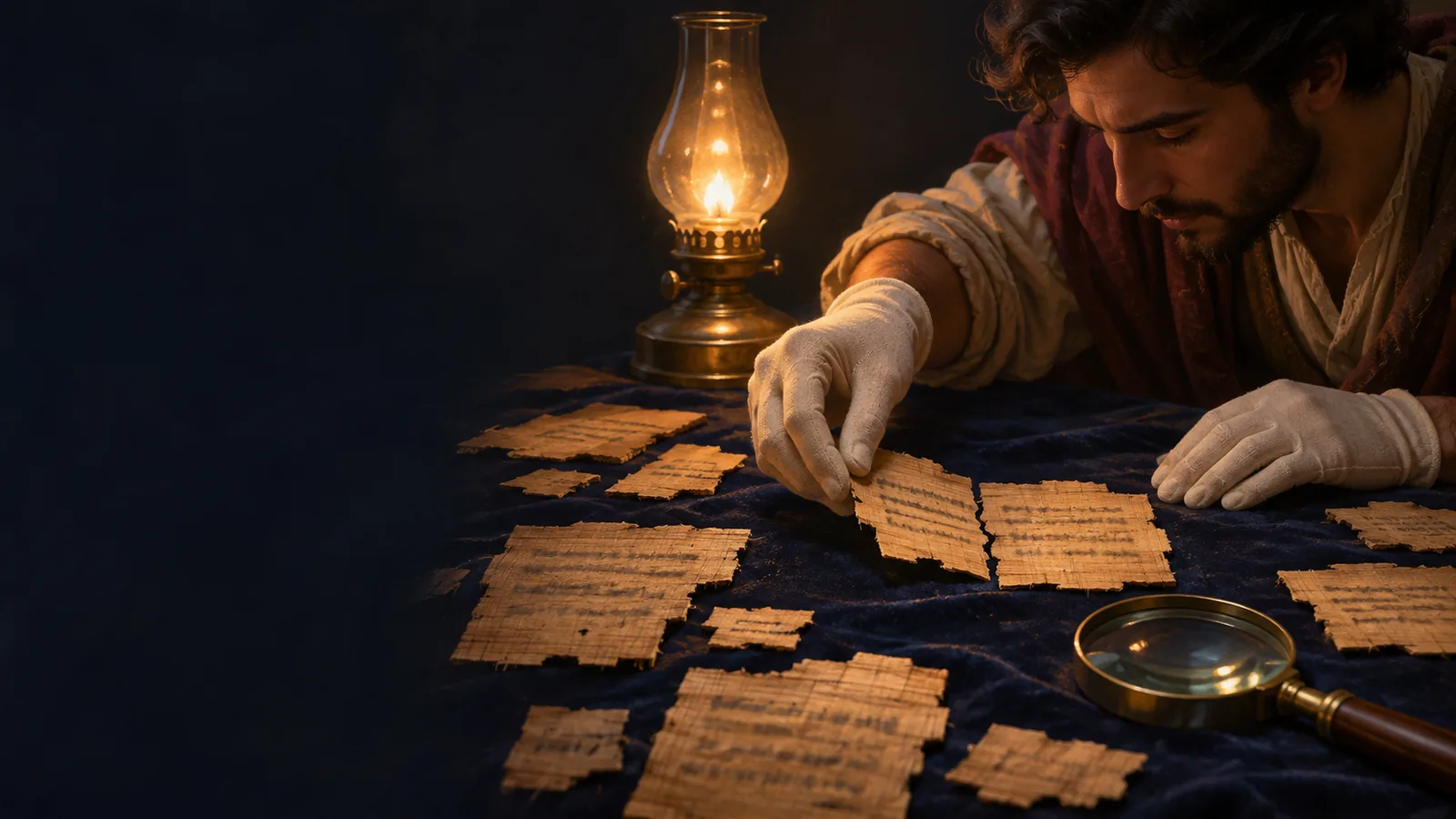
Why it matters for reading Scripture
Before anyone can say what the text says, the original wording must be known. Textual criticism weighs the manuscripts and the variants, and answers the question "has the Bible changed?"
Biblical studiesWhat does the text say?
Textual criticism is the study that seeks to recover the earliest attainable wording of the biblical text from the surviving witnesses: manuscripts, ancient translations and quotations. It weighs competing readings, explains how copies came to differ, and produces critical editions. It establishes wording, not meaning or theological truth, and is distinct from the higher criticism of sources and authorship.
Study v1.1, 16 October 2026
Before anyone can say what the text says, the original wording must be known. Textual criticism weighs the manuscripts and the variants, and answers the question "has the Bible changed?"
The evidence supports neither an unchanged Bible nor one changed beyond recovery: the earliest attainable text is recoverable with confidence in most places, while some passages remain unresolved.
Positions run from the mainstream critical text to Byzantine priority, Textus Receptus advocacy and King James Onlyism; the Muslim charge of corruption is answered separately.
The Muslim charge of corruption is answered separately.
Weighs external and internal evidence together, case by case, and prefers the reading that best accounts for the existence of the others.
Michael W. Holmes describes it as the approach of most current critics. The Münster editors reconstruct the initial text with the help of the Coherence-Based Genealogical Method, which itself makes no textual decisions.
Decides chiefly on internal grounds, such as authorial usage, the history of Greek and paleography, and does not favor a reading merely because it occurs in a superior, old or majority witness.
Its proponents include G. D. Kilpatrick and J. K. Elliott.
Holds that the Byzantine Textform, the form of text that predominated in the Greek-speaking world from at least the fourth century until printing, best preserves the text.
It is a text-critical method, not a defense of the textus receptus: it rejects conjectural emendation and weighs witnesses after reducing related manuscripts genealogically. Maurice A. Robinson explains the loss of early Byzantine exemplars by copying revolutions from papyrus to vellum and from uncial to minuscule.
Holds that a reading overwhelmingly attested by the manuscript tradition is more likely to be original than its rivals.
On that ground the edition of Zane C. Hodges and Arthur L. Farstad rejects the textus receptus readings at Acts 8:37 and 1 John 5:7 to 8, which most manuscripts lack.
Holds that God has providentially preserved his Word and that the preserved text is found in the Masoretic Hebrew and the Received Text, the editions of the Greek New Testament that follow the early printed editions of Erasmus.
The Trinitarian Bible Society, through which the position is chiefly documented, holds that critical texts were constructed without adequate regard to the historical place given to manuscripts.
Grounds its preference for the textus receptus in the Reformed confessions, holding that God has kept his written Word pure in all ages in the original-language apographs.
Textual work, on this view, must proceed ministerially, under the authority of Scripture. It denies that the King James translators were immediately inspired.
Covers a range of positions: a preference for the King James Version, its exclusive use, belief that the text underlying it is the preserved text, and, at the far end, claims that the English itself is inspired or can correct the Greek and Hebrew.
The Dean Burgon Society defends the King James Version as a true, faithful and accurate translation, while Peter Ruckman, at the far end of the range, taught that it is perfect and infallible.
Treats the Masoretic Text as authoritative, and Maimonides lists the omission or addition of even a single letter among the faults that disqualify a Torah scroll.
Changes to the text are considered sacrilegious, though small spelling variants between scribal traditions are known.
Divino afflante Spiritu (1943) holds that the original text has more authority than any translation and that the Vulgate's authenticity is juridical rather than critical.
The Pontifical Biblical Commission's The Interpretation of the Bible in the Church (1993) says textual criticism begins the series of scholarly operations, seeking a text as close as possible to the original. For translation, the instruction Liturgiam authenticam (2001) makes the Nova Vulgata the point of reference for the canonical text.
Uses the Septuagint for the Old Testament, though Eugen Pentiuc, as his reviewers report, holds that the Orthodox have never designated an official Old Testament text and are not against the Hebrew text.
For the New Testament the reference text is the Patriarchal edition of 1904, whose textual basis is disputed: Ioannis Karavidopoulos describes it as based entirely on Byzantine lectionaries, while Jovan Stanojević finds it closer to the textus receptus.
Origen compiles the Hexapla, setting the Hebrew, the Hebrew in Greek letters, Aquila, Symmachus, the Septuagint and Theodotion in six columns and marking differences with the obelus and the asterisk. Field held that it was composed before Origen's letter to Africanus of about 240.25
The Masoretes, at academies in Babylonia and Palestine, count the verses, words and letters of the Hebrew text so that later changes can be detected, and the Tiberian vocalization becomes dominant.28
Erasmus's Greek New Testament appears on 1 March under the title Novum Instrumentum omne. The printed text descended from it, later called the textus receptus, governs Protestant Bibles for three centuries.31
The preface to the Elzevir edition calls its text the one now received by all, from which the name Textus Receptus derives.31
Johann Albrecht Bengel's Greek New Testament appears at Tübingen. Bengel recognized that witnesses must be weighed, not counted, and is credited with the rule that the difficult reading stands before the easy one.31
Benjamin Kennicott's collation of Hebrew manuscripts appears at Oxford, the first systematic examination of them, showing the practical uniformity of the Masoretic text.32
Karl Lachmann's Greek text is the first to be recognized as a decisive break from the textus receptus.33
The first Dead Sea Scrolls are found near Qumran. The scrolls have changed how the history of the Hebrew text is understood.40
Kurt Aland founds the Institute for New Testament Textual Research (INTF) at Münster.41
Gather the witnesses: Greek manuscripts are the principal evidence, with ancient versions and patristic citations as further witnesses47.
Find the points at which the witnesses differ, the variants, and register them in an apparatus4748.
Weigh the external evidence: witnesses are weighed rather than counted, and manuscripts copied from a common ancestor count as a single witness3149.
Weigh the internal evidence: the fit of each reading with the context, style and logic of its passage, and whether an error of sight, hearing or memory, or a deliberate change, explains how it arose49.
Use the classic rules of thumb with care: the more difficult reading is the more probable only all other things being equal, and the shorter-reading rule has been challenged4950.
Adopt the reading that best satisfies both external and internal criteria and best accounts for the existence of the others511.
For the Hebrew Bible, retrovert the Septuagint into Hebrew where a one to one correspondence permits it, and separate genuine variants from pseudo-variants that exist only in the translator's mind52.
Admit conjectural emendation, a reading no surviving manuscript contains, only as a last resort; Byzantine priority rejects it outright496.
The works below shaped the field and are cited in this study, from the earliest to the most recent. Hover over a book, or select it, to see its author and the sources behind it.
Listed because this study draws on their published work; no association with or endorsement of Numa Verse is implied. Suggest a correction.
The words that carry the most weight in this field, each defined from the sources of this study. Turn a card over to read its definition.
 AI-generated imageTextual criticism
 AI-generated imageTextual criticism
 AI-generated imageTextual criticism
The evidence supports neither the claim of an unchanged text nor the claim of a text changed beyond recovery. The surviving manuscripts vary in a great many small ways and a few significant ones; what can be recovered is the earliest attainable text, in most places with confidence but not with certainty, and some passages remain unresolved97. Ehrman, Wallace and Gurry all state that the known variants do not overturn core Christian doctrines, though they disagree on whether doctrine is the right measure of significance9899100101.
On 29 September 2023 the Gregory-Aland list held about 5,700 entries, 5,541 of them neither destroyed nor presumed missing by the INTF post's own count59102. A number designates a distinct witness, not necessarily one physical object, and specialists put the number of Greek manuscripts at about 5,100 to 5,300 rather than the 24,000 sometimes cited59103.
About half a million, on Peter Gurry's estimate, which counts non-spelling differences in wording among Greek manuscripts and excludes translations and patristic citations100. Over half of them appear in only one manuscript, and Daniel Wallace holds that only about 1 percent are both meaningful and viable10099.
Reviewed and approved by Duane Herholdt, BA (Theology), Chief Executive Officer, Numa Verse
Study version: v1.1, 16 October 2026 (theology map v1.27)
Last reviewed: 6 November 2026