
Has the Bible been changed over the centuries?
Hebrew copies of the Old Testament made a thousand years apart agree closely. Scholars also find real differences between them, mostly in spelling and small details, and in a few books, larger ones.

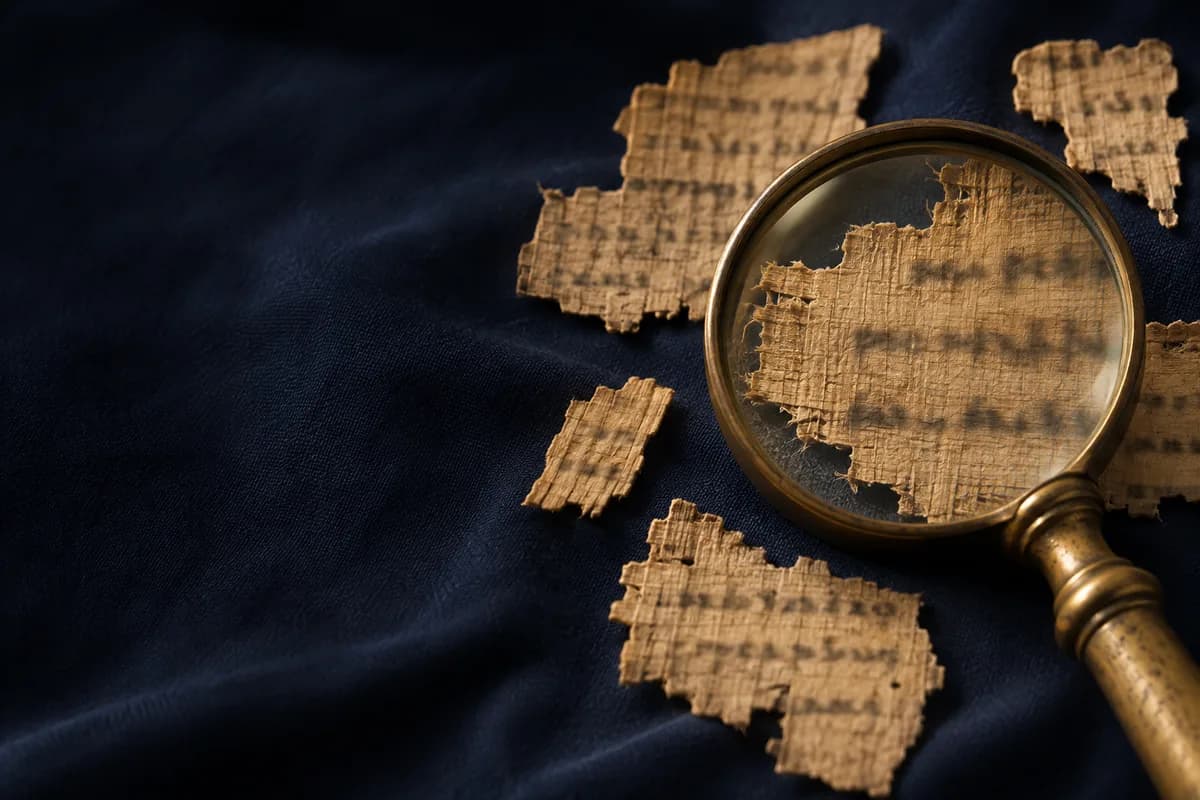
 AI-generated image
Until 1947, the oldest Hebrew Bibles were medieval
Before the Dead Sea Scrolls came to light, the oldest substantial Hebrew Bibles were books copied about a thousand years after the time of Christ. They carry what is called the Masoretic Text, from a Hebrew word meaning "tradition." Jewish scholars in academies in Babylonia and Palestine compiled it in work that began around the sixth century AD and was completed in the tenth [2].
Two manuscripts of this text stand out. The Aleppo Codex was written around AD 930 by a scribe named Solomon ben Buya'a, then corrected, supplied with vowels, and annotated by Aaron ben Moses ben Asher [3]. It once held the whole Hebrew Bible in about 487 leaves, of which 294 reached Jerusalem, where it is kept today [11]. The Leningrad Codex, copied in the first decade of the eleventh century, is the oldest complete manuscript written in the Ben Asher system, and it has been in the National Library of Russia in St. Petersburg since the mid-1800s [4]. Most modern printed editions of the Hebrew Bible use it as their base text [4].
The Masoretes built checks into the text
The Masoretes set out to guard the text they received. Hebrew had traditionally been written without vowels, so they added vowel signs to preserve the correct pronunciation, and accent marks to guide reading aloud in the synagogue [2]. They flagged unusual spellings and grammar and recorded places where manuscripts disagreed [2].
Their best-known safeguard was counting. After finishing each section, they counted its verses, words, and letters, and noted which verse, word, and letter stood at the center, so that later copies could be checked against them [2]. Britannica credits this care for the consistency of Hebrew texts ever since, noting that the earliest printed Hebrew Bibles of the late fifteenth century closely match the earliest surviving codices of the late ninth century [2].
That left an open question. The Masoretes could protect the text from their own day forward, but had it already drifted in the centuries before them? Apart from the Nash Papyrus, a second-century BC sheet with the Ten Commandments and the Shema, no Hebrew biblical manuscripts from that earlier period were known [12].
 AI-generated image
The Dead Sea Scrolls let scholars look a thousand years further back
The scrolls found near Qumran, by the Dead Sea, gave scholars their first direct look at the Hebrew Bible in the time before Christ. The Great Isaiah Scroll was one of the original seven scrolls discovered at Qumran in 1947 [5]. The best-known finds came from 11 caves near the site, mostly in the form of thousands of fragments, and the Qumran scrolls date from the third century BC to the first century AD [1]. About 230 manuscripts are biblical, and every book of the Hebrew Bible except Esther is represented [1].
The Great Isaiah Scroll, known to scholars as 1QIsa-a, is 7.34 meters long and preserves all 66 chapters of the book, with only small gaps [5]. It dates to the second century BC, and a recent study combining digital handwriting analysis with radiocarbon testing placed it between 180 and 100 BC [5]. That makes it roughly a thousand years older than the Aleppo Codex.
Set beside the medieval codices, the scroll is recognizably the same book of Isaiah. The Israel Antiquities Authority, which publishes the scrolls in its Leon Levy Dead Sea Scrolls Digital Library, says many biblical scrolls closely resemble the Masoretic Text, which it calls remarkable given that they are over a thousand years older than the biblical manuscripts known before [1].
Agreement with real and identifiable differences
The differences fall into kinds that scholars can name. The most common is spelling: some scrolls depart from Masoretic spelling and word forms [1], and the Isaiah scroll itself shows differences in spelling and word forms between its two halves, which divide after chapter 33 [5]. The scroll also bears hundreds of corrections, repairs, and touch-ups by at least seven hands, added over at least a century [5]. Marcello Fidanzio of the Università della Svizzera Italiana, who studied it, said the manuscript "was not static, but full of life" [5].
Some scrolls go further, with additions and omissions that suggest copyists of the period adjusted texts as they worked [1]. Jewish communities in the Second Temple period did not yet share one unified, authoritative collection of Scripture [1]. Scrolls found in the refuge caves of the second century AD, however, match the Masoretic Text, which suggests that, at least among the communities that left them, one form of the text had become standard by then [1].
The Septuagint shows that some books circulated in more than one edition
The Septuagint, the Greek translation of the Hebrew Scriptures, is an independent witness because it was made from Hebrew copies far older than the Masoretes. Ancient tradition credited it to 72 Jewish translators brought to Egypt from Jerusalem in the third century BC, an account scholars treat as legend [6].
Jeremiah shows the largest gap. Tov puts the Masoretic Text of Jeremiah at about 20 percent longer than the Greek, and the two arrange parts of the book differently, most notably the oracles against foreign nations [6]. Two Hebrew fragments from Qumran, 4QJer-b and 4QJer-d, are shorter than the Masoretic Text in the same way the Greek is, and one arranges verses as the Greek does [6]. The textual scholar Emanuel Tov drew the conclusion that a shorter Hebrew form of Jeremiah served as the model for the Greek, so the translator was not cutting the book down [6].
Orthodox writers weigh the two texts in different ways. Father John Whiteford, an Orthodox priest and writer, holds that the Church preserved the Septuagint as its authoritative text, and that the Masoretic Text, preserved outside the Church, is worth studying but not equally trustworthy [10]. He points to Deuteronomy 32:43, where a Hebrew text from the Dead Sea Scrolls contains a line found in the Greek and quoted in Hebrews 1:6 [10].
A third ancient witness is the Samaritan Pentateuch, the five books of Moses as kept by the Samaritan community. Scholars count about 6,000 differences between it and the Masoretic Text, most of them spelling or grammar that leave the meaning unchanged, and in about 2,000 of them it agrees with the Septuagint [13].
Where the claim comes from, and how traditions answer it
The claim that the Bible has been changed has more than one root. In Islamic thought, four verses of the Qur'an accuse Jews of tahrif (falsification) and tabdil (alteration) of the words or meaning of the Torah [7]. For centuries many Sunni and Shi'i scholars held that the biblical text itself had been corrupted, and Ibn Hazm was among the sharpest critics of the Bible [7]. Other scholars, among them Montgomery Watt and Mahmud Ayoub, argued that the Qur'an's wording does not support the later claim that the whole Bible was corrupted [7]. A second root is common sense about hand copying, which the manuscripts partly confirm: copyists did make errors, and some books did exist in different forms.
Christian traditions answer in their own terms. The Westminster Confession, a Reformed Protestant standard, holds that the Hebrew Old Testament was by God's "singular care and providence kept pure in all ages" [8]. Pope Pius XII, in the encyclical Divino Afflante Spiritu of 30 September 1943, urged Catholic scholars to restore the original text as perfectly as possible, free of copyists' errors, and taught that the original carries more authority than even the best translation [9]. Some Orthodox writers, Whiteford among them, locate the preserved Old Testament in the Greek text the Church has always read [10].
What this means for the reader
The evidence does not show a Bible rewritten beyond recognition, and it does not show a text untouched by human hands. It shows Isaiah copied with great faithfulness across a thousand years, alongside a few books, Jeremiah above all, that circulated in more than one ancient edition, and differences small enough that scholars can list and study them openly.
Sources
- 1Israel Antiquities Authority, "Introduction," Leon Levy Dead Sea Scrolls Digital Library, n.d. (accessed 3 November 2026).https://www.deadseascrolls.org.il/learn-about-the-scrolls/introduction (opens in a new tab)
- 2Encyclopaedia Britannica, "Masoretic text," n.d. (accessed 3 November 2026).https://britannica.com/topic/Masoretic-text (opens in a new tab)
- 3Encyclopaedia Britannica, "Aleppo Codex," n.d. (accessed 3 November 2026).https://www.britannica.com/topic/Aleppo-Codex (opens in a new tab)
- 4West Semitic Research Project, University of Southern California, "The Leningrad Codex," n.d. (accessed 3 November 2026).https://dornsife.usc.edu/wsrp/?p=385 (opens in a new tab)
- 5Rossella Tercatin, "'The manuscript was not static, but full of life': the oldest complete biblical scroll ever found was originally split in two, scholar finds," The Times of Israel, 2026.https://www.timesofisrael.com/the-oldest-complete-biblical-scroll-ever-found-was-originally-split-in-2-scholar-finds/ (opens in a new tab)
- 6Emanuel Tov, "The Book of Jeremiah: A Work in Progress," Bible Review, June 2000, Biblical Archaeology Society Library.https://library.biblicalarchaeology.org/article/the-book-of-jeremiah-a-work-in-progress/ (opens in a new tab)
- 7Stephen Lambden, "The Bible, the Qur'an and the Question of Tahrif ('falsification') and Tabdil ('alteration')," Hurqalya Publications, University of California, Merced, 2017.https://hurqalya.ucmerced.edu/node/3371 (opens in a new tab)
- 8Westminster Assembly, The Westminster Confession of Faith, chapter 1, 1646, Christian Classics Ethereal Library.https://www.ccel.org/creeds/westminster.htm (opens in a new tab)
- 9Pope Pius XII, Divino Afflante Spiritu, encyclical on the promotion of biblical studies, 1943, The Holy See.https://www.vatican.va/content/pius-xii/en/encyclicals/documents/hf_p-xii_enc_30091943_divino-afflante-spiritu.html (opens in a new tab)
- 10John Whiteford, "The Septuagint vs. the Masoretic Text," Pravoslavie.ru, n.d. (accessed 3 November 2026).https://pravoslavie.ru/81224.html (opens in a new tab)
- 11Yad Izhak Ben-Zvi. "The Aleppo Codex." Accessed 2026.https://ybz.org.il/?p=162954 (opens in a new tab)
- 12Cambridge University Library. "Nash Papyrus," MS Or. 233, Cambridge Digital Library. Accessed 2026.https://cudl.lib.cam.ac.uk/view/MS-OR-00233/3 (opens in a new tab)
- 13Kehillat Israel. "Samaritan Pentateuch." Accessed 2026.https://kehillatisrael.net/?p=3987 (opens in a new tab)
From the Journal
Related from the Journal
 AI-generated imageTextual criticism
How do we know what the New Testament originally said?
No original survives, so scholars compare thousands of copies, early translations, and quotations to work back toward the earliest text. Most differences are minor, and modern Bibles mark the significant ones.Numa Verse Editorial · November 2026 · 6 min read AI-generated imageTextual criticism
Why does the Lord's Prayer end differently in different Bibles?
The familiar ending, "For Yours is the kingdom and the power and the glory forever", is missing from the oldest manuscripts of Matthew. It is very old, but most scholars hold it entered the text from Christian worship, which is why modern Bibles print it in a note. The churches still pray it, each in its own way.Numa Verse Editorial · November 2026 · 4 min read AI-generated imageFoundations