
How do we know what the New Testament originally said?
No original survives, so scholars compare thousands of copies, early translations, and quotations to work back toward the earliest text. Most differences are minor, and modern Bibles mark the significant ones.

 AI-generated image
The originals are lost, but the copies are many
None of the original documents of the New Testament, which scholars call the autographs, is known to survive, so everything that exists today is a copy [1]. The Chicago Statement on Biblical Inerrancy, a widely cited evangelical Protestant document, ties inspiration to the autographic text and holds that this text "can be ascertained from available manuscripts with great accuracy" [1]. The editors of the Eastern Orthodox Bible describe the Greek text their churches use as a church text, not a speculative reconstruction of the lost originals [10].
What survives in Greek is large. The Institute for New Testament Textual Research (INTF) in Münster, Germany, keeps the official register of Greek New Testament manuscripts. Writing on the institute's blog, Katie Leggett and Greg Paulson put the register at about 5,700 entries, a figure they called a snapshot that shifts as manuscripts are found or lost [2]. After they remove the 56 manuscripts recorded as destroyed and others that are missing or cannot be traced, the count falls to 5,541 [2].
The earliest witnesses
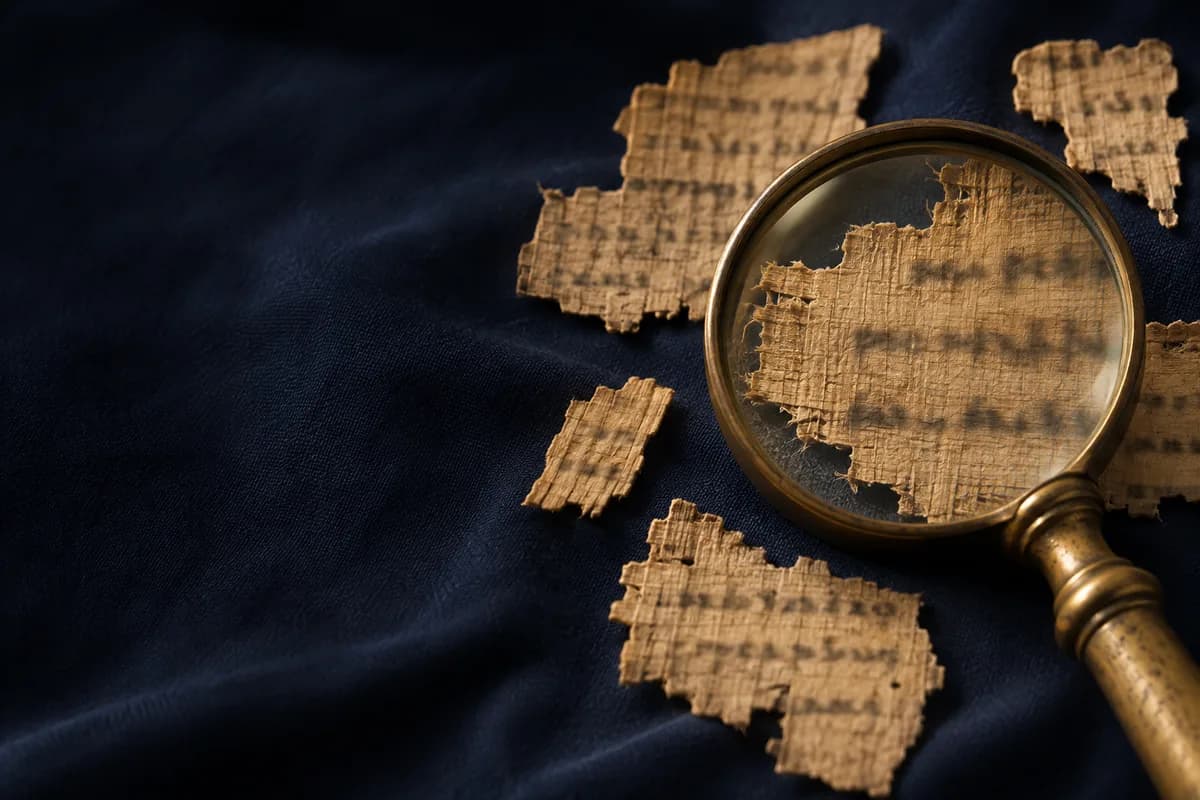
The oldest surviving pieces are papyrus fragments from Egypt, and their dates are debated. The best known is P52, a small piece of the Gospel of John held by the John Rylands Library in Manchester, which the library calls "widely regarded as the earliest portion of any New Testament writing ever found" [3]. Its first editor dated it by its handwriting to between AD 100 and 150, while the library reports that more recent research points to a date nearer AD 200 [3]. It has never been carbon dated, because the test would destroy part of it [3].
Two larger papyrus books, P66 and P75, both preserve the Gospel of John [8], and scholars group their text with the form found in Codex Sinaiticus and Codex Vaticanus, two large bound books copied in the fourth century [5, 8]. Most textual critics give this Alexandrian text the greatest weight as a witness to the earliest recoverable text, though some French scholars have favored the Western text, an early form behind the Old Latin translations [5].
Beyond Greek, many thousands of manuscripts survive in ancient translations, among them Latin, Syriac, Coptic, Slavic, Ethiopic, and Armenian, and early translations show what Greek wording the translators had in front of them [5]. Jerome, for example, revised the Latin Gospels against Greek manuscripts in the 380s [8]. Church writers also quoted Scripture constantly, and because many of them can be dated, their quotations help show how early a reading existed. Hort, who with Westcott produced an influential critical text, used this evidence to argue that readings found only in later Byzantine manuscripts do not appear in Christian writings before the fourth century [5]. The Eastern Orthodox Bible likewise records patristic quotations in its notes on significant variants [10].
 AI-generated image
How variants are compared, and what most of them are
A variant is any place where the manuscripts differ, and there are many of them. Bart Ehrman, a New Testament scholar who writes for general readers, puts the number of differences at roughly 400,000 to 500,000 [6]. He says most are trivial and many cannot even be seen in English translation, adding that "the majority matter only for scribes in a spelling bee contest" [6]. Ehrman also argues that a variant can matter even when no doctrine rests on it, because one reading can change how a Gospel story is told [6].
Comparison starts from a principle set out by Hort: where manuscripts differ, at most one reading can be original [5]. Scholars then ask which reading best explains how the others arose, and in many places the Alexandrian reading is judged to do so [5]. A minority of scholars, including Zane Hodges and Arthur Farstad, and Maurice Robinson and William Pierpont, have produced editions that follow the Byzantine text found in most surviving manuscripts [5]. They argue that the many later Byzantine copies imply that lost earlier copies were mostly Byzantine too, and that Egypt's climate explains why its surviving papyri reflect a different stream [5]. The Byzantine text also underlies the Textus Receptus, the printed Greek text behind the King James Version [5].
Two well-known disputed passages
Two passages show how this works in practice. The first is the ending of Mark: in the NIV, verses 9 to 20 of chapter 16 are set apart, with a note that the earliest manuscripts and some other ancient witnesses do not have them [7]. The second is the account of the woman caught in adultery, John 7:53 to 8:11. The NIV notes that the earliest manuscripts and many other ancient witnesses lack it, and that a few manuscripts place it elsewhere in John or in Luke [7].
In John's case, P66, P75, Codex Sinaiticus, and Codex Vaticanus all lack the passage, and the earliest Greek manuscript that includes it is Codex Bezae, from the fifth or sixth century [8]. Around AD 417, Jerome reported finding it in many Greek and Latin manuscripts, and Augustine defended its place in the Gospel [8].
Marking a passage is not the same as removing it, and the NIV prints both passages in full [7]. The Catholic Church regards the account in John as canonical Scripture, following the Council of Trent, and some Catholic editions print it without brackets but with a note on its textual history [8]. In Greek Orthodox worship, the Gospel reading for Pentecost runs from John 7:37 to 8:12 and passes over these twelve verses [8].
How the traditions relate to the critical text
The standard scholarly edition is the Nestle-Aland Novum Testamentum Graece, now in its 28th edition (NA28), which revised its record of variant readings and, for the letters from James to Jude, brought more than 30 changes to the text [4].
Catholic teaching welcomed this kind of work. In his 1943 encyclical Divino Afflante Spiritu, Pope Pius XII called textual criticism a valuable aid for restoring the sacred text, urged Catholic scholars to prepare critical editions, and encouraged translations made directly from the original languages [9]. He explained that the Council of Trent's endorsement of the Latin Vulgate concerned its public use in the Latin Church, an authority he called juridical rather than critical [9].
Greek Orthodox churches use the Patriarchal Text, published in 1904 by the Ecumenical Patriarchate of Constantinople after a committee studied about 20 major Byzantine manuscripts, and it stands very close to the Byzantine text [10]. According to the editors of the Eastern Orthodox Bible, many Orthodox hierarchs and theologians favor that text as the one the Church copied and trusted most, and translations based on the critical text are generally not used in Orthodox worship [10]. The Eastern Orthodox Bible still footnotes every significant difference from the critical text, treats the scholarly debate as open, and states that "no doctrine is ever at stake" in these variants [10].
Protestants hold no single position. Widely used translations such as the NIV and NRSV rest on the critical text [10], the King James Version rests on the Textus Receptus [5], and the Chicago Statement denies that any essential element of the faith is affected by the loss of the autographs [1].
What this means for the reader
We know what the New Testament originally said by comparing an unusually large body of copies, translations, and quotations, and the places where doubt remains are marked openly in modern Bibles. What scholars reconstruct is the earliest text the evidence allows, which is not the same as holding the autographs. The traditions differ on which form of the text they read in church, and each has set out its reasons in its own published texts.
Sources
- 1International Council on Biblical Inerrancy. "The Chicago Statement on Biblical Inerrancy." Hosted by Carolina University School of Divinity. 1978.https://divinity.carolinau.edu/chicago-statement-biblical-inerrancy (opens in a new tab)
- 2Katie Leggett and Greg Paulson, Institute for New Testament Textual Research (INTF). "How Many Greek New Testament Manuscripts Are There REALLY? The Latest Numbers." INTF Blog. 2023.https://ntvmr.uni-muenster.de/de/intfblog/-/blogs/how-many-greek-new-testament-manuscripts-are-there-really-the-latest-numbers (opens in a new tab)
- 3The University of Manchester Library, John Rylands Library. "St John Fragment: What is the significance?" Undated.https://www.library.manchester.ac.uk/rylands/special-collections/exploring/guide-to-special-collections/st-john-fragment/what-is-the-significance/ (opens in a new tab)
- 4Deutsche Bibelgesellschaft. "The NA28." Undated.https://www.die-bibel.de/en/the-na-28 (opens in a new tab)
- 5Wikipedia. "Textual criticism of the New Testament." Accessed 2026.https://en.wikipedia.org/wiki/Textual_criticism_of_the_New_Testament (opens in a new tab)
- 6Bart D. Ehrman. "If Textual Variants Don't Change Any Key Doctrines, Then Who Cares?" The Bart Ehrman Blog podcast. 2024.https://the-bart-ehrman-blog.castos.com/episodes/if-textual-variants-dont-change-any-key-doctrines-then-who-cares (opens in a new tab)
- 7Bible Gateway. Mark 16:8-20 and John 7:53-8:11, New International Version. Accessed 2026.https://www.biblegateway.com/passage/?search=Mark%2016%3A8-20%3B%20John%207%3A53-8%3A11&version=NIV (opens in a new tab)
- 8Wikipedia. "Jesus and the woman taken in adultery." Accessed 2026.https://en.wikipedia.org/wiki/Jesus_and_the_woman_taken_in_adultery (opens in a new tab)
- 9Pope Pius XII. Divino Afflante Spiritu (encyclical on promoting biblical studies). Holy See. 1943.https://www.vatican.va/content/pius-xii/en/encyclicals/documents/hf_p-xii_enc_30091943_divino-afflante-spiritu.html (opens in a new tab)
- 10Laurent Cleenewerck, editor. "About the EOB New Testament," in The Eastern Greek Orthodox Bible: New Testament. Hosted by Azbyka.ru. Undated.https://azbyka.ru/otechnik/world/new-testament-the-eastern-greek-orthodox-bible/4_5 (opens in a new tab)
From the Journal
Related from the Journal
 AI-generated imageTextual criticism
Has the Bible been changed over the centuries?
Hebrew copies of the Old Testament made a thousand years apart agree closely. Scholars also find real differences between them, mostly in spelling and small details, and in a few books, larger ones.Numa Verse Editorial · November 2026 · 6 min read AI-generated imageTextual criticism
Why does the Lord's Prayer end differently in different Bibles?
The familiar ending, "For Yours is the kingdom and the power and the glory forever", is missing from the oldest manuscripts of Matthew. It is very old, but most scholars hold it entered the text from Christian worship, which is why modern Bibles print it in a note. The churches still pray it, each in its own way.Numa Verse Editorial · November 2026 · 4 min read AI-generated imageFoundations