
How did the Bible get its chapters and verses?
The biblical authors wrote without numbered chapters or verses. The chapters most Bibles use go back to Stephen Langton in Paris in the early 1200s; the verse numbers came from Jewish scholarship on the Hebrew text and from the printer Robert Estienne, whose New Testament numbering appeared in 1551.

 AI-generated image
Written without numbers
None of the books of the Bible was written with chapter or verse numbers. They were added much later to help readers find their place, and they form part of the apparatus around the text rather than the text itself [1]. Many of the Church Fathers lived and taught without ever seeing a numbered Bible [2]. That is worth remembering when a single verse is quoted on its own: the number marks a place in a longer passage, not the edges of a separate saying.
Verses in the Hebrew Bible
The division of the Hebrew text into verses is old. In Hebrew manuscripts the end of each verse is marked by a sign called sof pasuq, two points like a colon, and the Talmud credits the verse division to the scribes, which places it before the Talmud itself [3]. The division is part of the Masoretic tradition, the system of notes and markings that Jewish scholars developed to preserve the text, and it is tied to the accents that guide how the text is read aloud [3]. Even so, the verse division was not written into the scrolls read in the synagogue [3].
Those verses were not numbered at first. Numbering them was a later step, and it came through a reference book. Between 1437 and 1445 (some accounts give 1447 or 1448) Isaac Nathan ben Kalonymus of Arles, in Provence, compiled the first concordance to the Hebrew Bible, modeled on a Latin concordance to the Vulgate [4]. He cited each passage by the number of its chapter in the Latin Bible and the number of its verse within the chapter, the way readers still do [5]. His concordance was first printed by Daniel Bomberg in Venice in 1523 [4].
 AI-generated image
Chapters from Paris
The chapters themselves came from the Latin Bible. In the early thirteenth century Stephen Langton, then a lecturer at the University of Paris and later Archbishop of Canterbury, introduced the chapter divisions that translations still use [6]. Other schemes existed in his time, but Langton's became the standard [1]. Jewish scholars adopted the Latin chapters for reference, and from the Bomberg Bible printed in Venice in the 1520s they appeared in printed Hebrew Bibles [3].
Verse numbers from a printer
In 1551 Robert Estienne, a French printer also known by his Latin name Stephanus, published a Greek and Latin New Testament in which each chapter was divided into numbered verses [6]. He had left Paris for Geneva, where that edition was printed [7]. In 1555 he published a Latin edition of the whole Bible with the Old Testament numbered as well, and his numbers became the ones still in use [6]. In his earlier editions the numbers stood in the margin; the 1555 Latin Bible is credited as the first to set them into the text [1].
Into English
English Bibles took up the system quickly. The Geneva New Testament of 1557 carried verse numbers, and the full Geneva Bible of 1560 was the first English Bible with both chapters and verses as they are numbered today [7][6]. The King James Version of 1611 and most English translations since have kept the same scheme.
Where the numbers do not match
Because the numbers were added from more than one source, they do not always agree. Hebrew and English Bibles differ in places. Hebrew Bibles, for example, number as 1 Chronicles 5:27–41 the verses that Christian translations number 1 Chronicles 6:1–15 [1]. In the Psalms, Hebrew Bibles usually count a psalm's title as verse 1, so a verse number in a Hebrew Psalm can be one higher than in an English Bible [1].
The New Testament has gaps of a different kind. Estienne numbered the Greek text he had, which was based on late manuscripts. Some verses in that text are missing from older manuscripts found since, so many modern translations move them to a footnote and skip the number [8]. A reader who sees Acts 8 jump from verse 36 to verse 38 is seeing that history.
Breaks in awkward places
The chapter breaks were made by careful readers, and most of them still serve well [9]. Some fall in awkward places. The well-known passage on the Suffering Servant begins at Isaiah 52:13, three verses before chapter 53 [10], so a reader who starts at chapter 53 misses its opening lines. Bible editions that print the text in paragraphs, with numbers small or removed, are one response, and they help a reader follow the argument the author wrote [2].
What this means for the reader
Chapter and verse numbers are a finding aid, not part of what the authors wrote. They are very useful for looking things up. To understand a verse, read the paragraph around it, and when a passage begins or ends at an odd place, look a few verses either side of the number.
Sources
- 1"Chapters and verses of the Bible," Wikipedia.https://en.wikipedia.org/wiki/Chapters_and_verses_of_the_Bible (opens in a new tab)
- 2St. Paul Center for Biblical Theology, "When Was the Bible Divided Into Chapter and Verse?"https://stpaulcenter.com/when-was-the-bible-divided/ (opens in a new tab)
- 3Jewish Encyclopedia (1906), "Verse-Division."https://www.jewishencyclopedia.com/articles/14682 (opens in a new tab)
- 4Jewish Encyclopedia (1906), "Concordance."https://www.jewishencyclopedia.com/articles/4584 (opens in a new tab)
- 5George F. Moore, "The Vulgate Chapters and Numbered Verses in the Hebrew Bible," Journal of Biblical Literature 12 (1893): 73–78.https://gospelstudies.org.uk/biblicalstudies/pdf/jbl/1893_073.pdf (opens in a new tab)
- 6Bart D. Ehrman, "Where Did the Chapter and Verse Divisions Come From?" The Bart Ehrman Blog.https://ehrmanblog.org/?p=48697 (opens in a new tab)
- 7Trinitarian Bible Society, "Verse Divisions in the Scriptures."https://www.tbsbibles.org/page/VerseDivisions (opens in a new tab)
- 8Eben De Jager, "How One Man Changed the Bible With Verse Numbers," TheCollector, 30 January 2026.https://www.thecollector.com/verses-christian-bible/ (opens in a new tab)
- 9Christian Today, "Who Divided the Bible Into Chapters and Verses?"https://www.christiantoday.com/article/who-divided-the-bible-into-chapters-and-verses/103616.htm (opens in a new tab)
- 10Isaiah 52:13–53:12, Berean Standard Bible.https://biblehub.com/bsb/isaiah/52.htm (opens in a new tab)
From the Journal
Related from the Journal
 AI-generated imageBibliology
Who decided which books are in the Bible?
No single person or meeting decided. Communities of faith recognized their books over centuries, and Jewish, Catholic, Orthodox, Protestant, and Ethiopian traditions still hold canons that differ in a few books.Numa Verse Editorial · November 2026 · 6 min read AI-generated imageFoundations
Can you trust what AI tells you about the Bible?
Sometimes, but not on its word alone. Chatbots summarize Scripture fluently, yet they can also invent verses and citations, so every answer needs checking against the Bible itself and published commentary.Numa Verse Editorial · November 2026 · 6 min read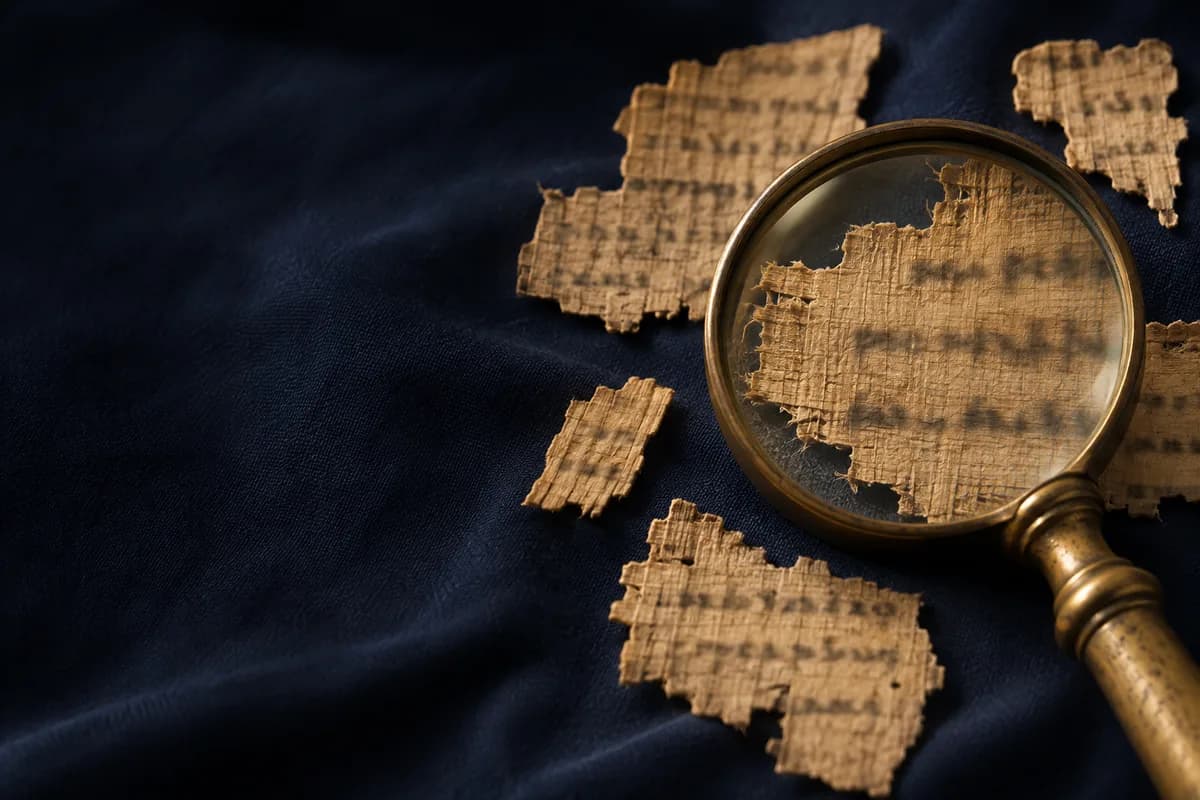 AI-generated imageTextual criticism