Which letters did Paul write?
Thirteen New Testament letters carry Paul's name. Seven are accepted as his across almost all modern scholarship; the other six are debated, and the traditions that hold all thirteen to be Paul's make their case from the early church's testimony. Hebrews does not name its author at all.

 AI-generated image
Thirteen letters with his name
The New Testament contains thirteen letters that open with Paul's name: Romans, 1 and 2 Corinthians, Galatians, Ephesians, Philippians, Colossians, 1 and 2 Thessalonians, 1 and 2 Timothy, Titus and Philemon [1]. The traditional view in Catholic, Orthodox and Protestant churches has been that Paul wrote all of them [2]. Since the nineteenth century, scholars have sorted them into groups by how securely each can be tied to him.
The seven undisputed letters
There is strong agreement across modern scholarship that Paul wrote Romans, 1 and 2 Corinthians, Galatians, Philippians, 1 Thessalonians and Philemon [1]. These seven share themes, vocabulary and style, and they are quoted or listed by the earliest sources [1]. The New Testament scholar James Dunn summarized the position: there is general agreement that these seven are authentic, while Paul's authorship of the other six cannot be taken for granted [3].
The sorting began with the German scholar Ferdinand Christian Baur around 1840, who accepted only four letters, Romans, 1 and 2 Corinthians and Galatians. Later nineteenth-century scholars widened that list to the seven now called undisputed [1].
 AI-generated image
The six disputed letters
The other six fall into two groups. Ephesians, Colossians and 2 Thessalonians are sometimes called deutero-Pauline, "second Pauline", letters [4]. Scholarly opinion on them is divided. A significant minority accept 2 Thessalonians as Paul's, a smaller group Colossians, and fewer still Ephesians [4]. Colossians shares names and greetings with Philemon, which some scholars take as evidence of the same author and others as evidence of an imitator who knew Philemon [1].
The Pastoral Letters, 1 and 2 Timothy and Titus, are the most widely doubted. Critics point to vocabulary not found in the undisputed letters, a more settled church order, and events in Paul's life that Acts and the other letters do not mention [2]. Other scholars, including Stanley Porter of McMaster Divinity College, have defended Paul's authorship of the Pastorals [2]. Scholars who hold that all thirteen are Paul's explain differences in style by his use of secretaries, his co-senders, and the different situations he addressed.
Paul did not write alone
The letters show how Paul worked. Several open in the name of Paul and his companions; 1 Thessalonians, for example, comes from Paul, Silvanus and Timothy [5]. Romans names the man who wrote it down: "I, Tertius, who wrote down this letter, greet you in the Lord" (Romans 16:22, BSB) [6]. In other letters Paul adds a greeting in his own hand, and 2 Thessalonians says, "This greeting is in my own hand—Paul. This is my mark in every letter; it is the way I write" (2 Thessalonians 3:17, BSB) [7]. Ancient letters were often dictated, which is why questions of style alone rarely settle authorship.
Letters that did not survive
Paul refers to letters we do not have. In 1 Corinthians he mentions an earlier letter: "I wrote you in my letter not to associate with sexually immoral people" (1 Corinthians 5:9, BSB) [8]. Colossians asks the church to read "the letter from Laodicea" (Colossians 4:16, BSB) [9]. No separate letter matching either can be securely identified; some scholars have suggested that the letter from Laodicea is the one we know as Ephesians. A later Latin text called the Epistle to the Laodiceans was written in Paul's name [4].
The oldest collection
The oldest surviving collection of Paul's letters is a papyrus codex known as P46, divided between the Chester Beatty Library in Dublin and the University of Michigan [10]. It is usually dated about AD 175 to 225 [10]. It places Hebrews directly after Romans, which suggests that the community that made it counted Hebrews among Paul's letters [10]. The surviving pages hold parts of nine letters, and the end of the codex is lost, so scholars cannot be sure whether it once held the Pastoral Letters [11].
What about Hebrews?
Hebrews names no author. Eastern churches early on tended to count it with Paul's letters, as P46 shows, while Western churches were slower to accept it: Eusebius records that in his own day some in Rome did not consider it the apostle's work [10][12]. In the third century the scholar Origen, quoted by Eusebius, concluded that only God knows who wrote it [12]. Most modern scholars, conservative and critical, do not think Paul wrote it. Early writers suggested others: Origen reports that some named Clement of Rome and others Luke [12], and Tertullian named Barnabas. Apollos was first proposed much later, by Martin Luther.
What this means for the reader
Seven letters give an agreed core of Paul's own voice, and the rest are read with that core in view. The traditions that accept all thirteen read them as Paul's teaching; many critical scholars read some as the teaching of his followers. Either way, all thirteen belong to the canon every major tradition received, and knowing the debate helps a reader notice where the letters differ in tone and setting.
Sources
- 1"Authorship of the Pauline epistles," Wikipedia.https://en.wikipedia.org/wiki/Authorship_of_the_Pauline_epistles (opens in a new tab)
- 2South African Theological Seminary, "Which Letters did Paul Write?", on Stanley Porter and Scot McKnight.https://sats.ac.za/resources/blogs/which-letters-did-paul-write (opens in a new tab)
- 3James Bishop, "Pauline Authorship: An Introductory Review," quoting James D. G. Dunn, Eerdmans Commentary on the Bible (2003), 1274.https://jamesbishopblog.com/2015/11/24/pauline-authorship-introductory-review-onymous-letters/ (opens in a new tab)
- 4Bart D. Ehrman, "What Books Did Paul Write in the Bible?"https://www.bartehrman.com/?p=9113 (opens in a new tab)
- 51 Thessalonians 1:1, Berean Standard Bible.https://biblehub.com/bsb/1_thessalonians/1.htm (opens in a new tab)
- 6Romans 16:22, Berean Standard Bible.https://biblehub.com/bsb/romans/16.htm (opens in a new tab)
- 72 Thessalonians 3:17, Berean Standard Bible.https://biblehub.com/bsb/2_thessalonians/3.htm (opens in a new tab)
- 81 Corinthians 5:9, Berean Standard Bible.https://biblehub.com/bsb/1_corinthians/5.htm (opens in a new tab)
- 9Colossians 4:16, Berean Standard Bible.https://biblehub.com/bsb/colossians/4.htm (opens in a new tab)
- 10Biblical Archaeology Society, image details for P46.https://library.biblicalarchaeology.org/?p=118558 (opens in a new tab)
- 11"The Construction and Contents of the Beatty-Michigan Pauline Epistles Codex (P46)," MF Norwegian School of Theology, 2022.https://hdl.handle.net/11250/3026309 (opens in a new tab)
- 12Eusebius, Church History 6.20.3 and 6.25.11–14, New Advent.https://www.newadvent.org/fathers/250106.htm (opens in a new tab)
From the Journal
Related from the Journal
 AI-generated imageNew Testament studies
Who wrote the four Gospels?
None of the four Gospels names its author in its own text. The names Matthew, Mark, Luke and John come from titles and from second-century church writers, and scholars still weigh how far that tradition reaches back. Most agree on one thing about how the first three relate: Mark came first.Numa Verse Editorial · November 2026 · 5 min read AI-generated imageFoundations
Can you trust what AI tells you about the Bible?
Sometimes, but not on its word alone. Chatbots summarize Scripture fluently, yet they can also invent verses and citations, so every answer needs checking against the Bible itself and published commentary.Numa Verse Editorial · November 2026 · 6 min read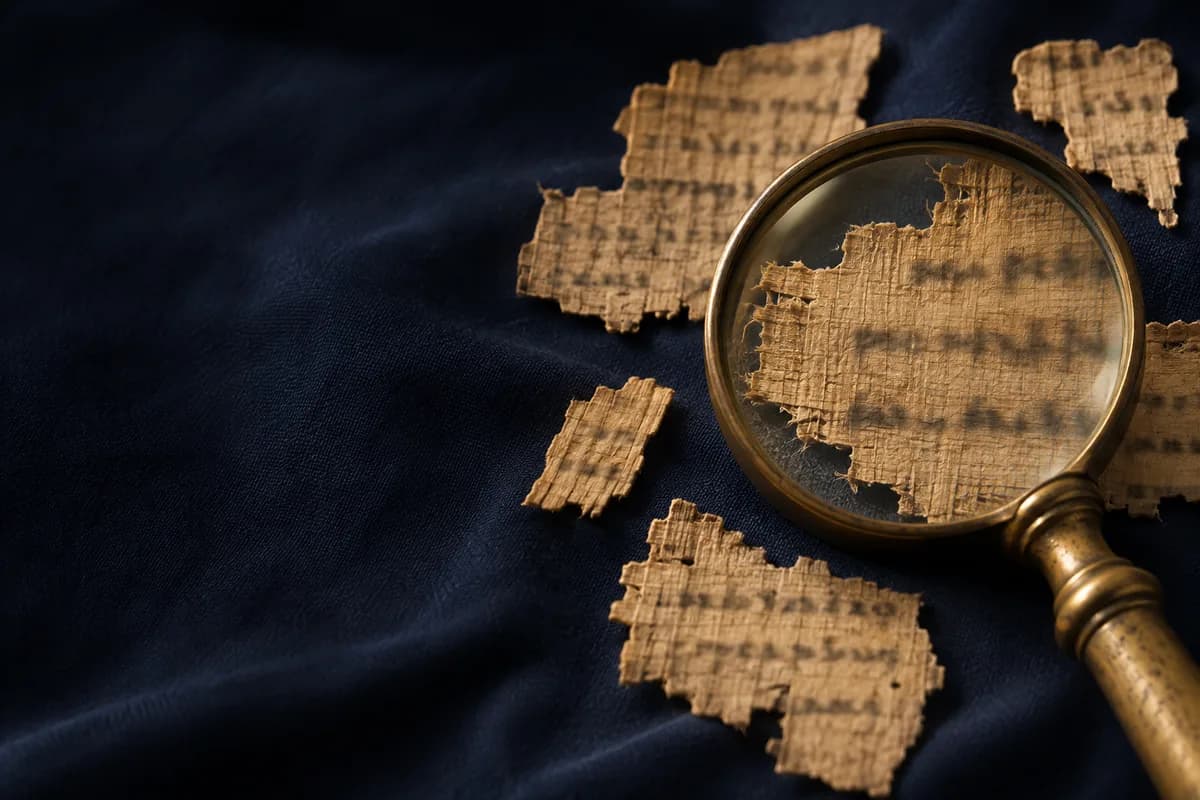 AI-generated imageTextual criticism