
What is the Book of Enoch, and why is it not in most Bibles?
The Book of Enoch is an ancient Jewish collection of five works credited to Enoch of Genesis. The Ethiopian and Eritrean Orthodox Tewahedo churches hold it as Scripture; most other churches do not.

 AI-generated image
A collection in five parts
The Book of Enoch, usually called 1 Enoch, is a collection of five separate works, all written in the name of the Enoch of Genesis 5, of whom the King James Version says, "Enoch walked with God: and he was not; for God took him" (Genesis 5:24, KJV). George Nickelsburg of the University of Iowa describes the collection as composed over a long span, from about 350 BC to the turn of the era [1]. In the standard chapter numbering it runs to about 108 chapters [3].
The first part, the Book of the Watchers (chapters 1 to 36), tells of the fall of the Watchers, angels who took human wives [7], and of Enoch's journeys through heaven and earth [3]. The second, the Parables or Similitudes (chapters 37 to 71), contains three parables centered on a heavenly figure called the Elect One and the Son of Man [3]. The third, the Astronomical Book (chapters 72 to 82), sets out the movements of the sun, moon, and stars [3]. The fourth, the Dream Visions (chapters 83 to 90), includes an allegory of Israel's history told through animals [3]. The fifth, the Epistle of Enoch (chapters 91 to 105), is a set of exhortations that contains the Apocalypse of Weeks, followed by a short conclusion [3].
Scholars date the parts differently, and the ranges are wide. For the Book of the Watchers, VanderKam notes Qumran copies from 200 to 150 BC and allows a third century origin, while Nickelsburg places its core (chapters 6 to 11) in the fourth century BC [2]. The Astronomical Book is at least as old as its earliest copy, which VanderKam dates to around 200 BC; Milik placed that copy in the late third or early second century BC [2]. VanderKam dates the animal allegory in the Dream Visions to the late 160s BC and the Epistle to around 170 BC, while Rost put most of the Epistle in the first century BC [2]. The Parables are the most disputed. Most specialists place them in the first century BC or the first century AD; Milik argued for a date near AD 270, which Charlesworth called speculative [2].
The number in the name matters. Two later works also carry Enoch's name. 2 Enoch, known only from Slavonic manuscripts, describes Enoch's journey through seven heavens and is dated by many scholars to the first century, though some place it considerably later [3]. 3 Enoch is a Hebrew work of Jewish mysticism in which Rabbi Ishmael ascends to heaven and meets Enoch, now called Metatron [3]. They are different books from 1 Enoch, with their own histories.
Aramaic fragments and an Ethiopian text
The oldest surviving copies of 1 Enoch are Aramaic fragments found among the Dead Sea Scrolls. Cave 4 at Qumran yielded pieces of 11 Aramaic manuscripts of parts of 1 Enoch, together covering perhaps one fifth of the text [1]. The same cave held nine Aramaic manuscripts of a related work, the Book of Giants, which is not part of 1 Enoch [1]. One of the Enoch manuscripts, catalogued as 4Q201, was copied around 200 to 150 BC, and the Library of Congress describes the book's original language as in all likelihood Aramaic [4]. Older scholarship had proposed Hebrew for some sections [3].
No fragment of the Parables has been found at Qumran [1]. Nickelsburg suggests this part developed in circles other than those that gathered the Qumran collection [1], and its absence is one reason the Parables are dated later than the rest [2].
The book was translated into Greek, and parts of that Greek version survive from Egypt [4]. The only version that preserves the whole collection is the Ethiopic [1], in Ge'ez, the ancient language into which the Ethiopian Bible was translated [7]. The oldest Ethiopic manuscripts known today, such as Kebrān 9 and EMML 2080, date from the fifteenth century, and possibly the late fourteenth [11].
 AI-generated image
Quoted in Jude, weighed by the early church
The best known link between 1 Enoch and the New Testament is Jude 14 to 15 [3]. Jude writes that "Enoch also, the seventh from Adam, prophesied of these, saying, Behold, the Lord cometh with ten thousands of his saints" (Jude 14, KJV), words drawn from 1 Enoch [3]. Jude's use of the passage shows that he knew it; churches have drawn different conclusions about what that means for the rest of the book.
Early Christian writers read the book in different ways. The Epistle of Barnabas used it [3], and Tertullian defended it as Scripture, pointing out that it has a testimony in the Apostle Jude [12]. Others were cautious. Augustine explained that writings under Enoch's name were kept out of the canon because their great age made their origin uncertain, so "the writings of these men could not be held as authoritative" [5]. He was careful to add that the issue was doubt over who wrote these texts, and that he did not reject the authority of the ancient patriarchs themselves [5]. By the fourth century the book had fallen out of favor in the West, and Jerome classed it as apocryphal, though it remained in use longer in the East [3].
Scripture in the Ethiopian and Eritrean churches
For two churches, 1 Enoch is part of the Bible. A United Bible Societies resource for translators states that it is canonical Scripture for the Ethiopian Orthodox Tewahedo Church and the Eritrean Orthodox Tewahedo Church [6]. The Ethiopian Bible is usually counted at 81 books, the largest of the major Christian canons, and includes Enoch and Jubilees [7].
That canon took shape on its own path. According to a 2026 Bible Gateway overview, most scholars think it was settled around the fifth or sixth century AD, and the split between the Western and Ethiopian churches after the Council of Chalcedon in AD 451 left each to decide its disputed books separately [7]. The same overview notes that the reason Ethiopian authorities kept Enoch when others did not is not known [7]. In these churches the book is read as Scripture, in its own right.
Why most other Bibles do not include it
Most other churches settled their Old Testaments without 1 Enoch, each by its own principles. Bible Gateway's overview explains that Jewish teachers and early church authorities did not regard the book as inspired, and that many in the Western churches followed the rabbis in judging that it was unlikely to come from the patriarch whose name it bears [7]. Early authorities did not generally treat it as heretical [7].
In the Catholic Church, the Catechism states that the Church discerned the list of sacred books through apostolic Tradition, and it names 46 Old Testament books [8]. Enoch is not among them [8].
Eastern Orthodox churches read the Old Testament in the Greek Septuagint. The Orthodox Study Bible's overview, by Bishop Basil of Wichita, lists 49 Old Testament books in that tradition, and Enoch is not one of them [9].
Protestant Bibles contain 66 books, and Enoch is not among them [7]. The Westminster Confession, a classic Reformed statement, lists the books it receives as Scripture and describes the books commonly called Apocrypha as "not being of divine inspiration" and of no authority in the church, though they may be read like other human writings [10].
What this means for the reader
The Book of Enoch is a real ancient text, older than the New Testament in most of its parts, and Jude knew it. Whether it belongs in the Bible depends on which church's canon you read: for Ethiopian and Eritrean Orthodox Christians it does, and for Catholic, Eastern Orthodox, and Protestant Christians it stands outside Scripture as a witness to what Jews of that era believed and hoped.
Sources
- 1George W. E. Nickelsburg (University of Iowa). "Dead Sea Scrolls Spotlight: The Book of Enoch." Biblical Archaeology Society Library, n.d.https://library.biblicalarchaeology.org/sidebar/dead-sea-scrolls-spotlight-the-book-of-enoch/ (opens in a new tab)
- 2Peter Kirby, ed. "1 Enoch" (scholarly introductions by J. C. VanderKam, M. McNamara, L. Rost, J. H. Charlesworth, and others). Early Jewish Writings, n.d.https://earlyjewishwritings.com/1enoch.html (opens in a new tab)
- 3Encyclopedia of the Bible. "Books of Enoch." Bible Gateway (HarperCollins Christian Publishing), n.d.https://www.biblegateway.com/resources/encyclopedia-of-the-bible/Books-Enoch (opens in a new tab)
- 4Library of Congress. "The Qumran Library." Scrolls from the Dead Sea exhibition, n.d.https://www.loc.gov/exhibits/scrolls/libr.html (opens in a new tab)
- 5Augustine of Hippo. The City of God, Book 15, chapter 23. Bibliothek der Kirchenväter, University of Fribourg, n.d.https://bkv.unifr.ch/works/cpl-313/versions/the-city-of-god/divisions/554 (opens in a new tab)
- 6United Bible Societies. "The Book of Enoch." Translator's resource, n.d.https://tips.translation.bible/tip_verse/en-1-3/ (opens in a new tab)
- 7Jacob Edson. "The Ethiopian Bible." Bible Gateway, 2026.https://www.biblegateway.com/learn/?p=8571 (opens in a new tab)
- 8Holy See. Catechism of the Catholic Church, "The Canon of Scripture," paragraph 120. 1993.https://www.vatican.va/content/catechism/en/part_one/section_one/chapter_two/article_3/iv_the_canon_of_scripture.html (opens in a new tab)
- 9Bishop Basil of Wichita. "Overview of the Books of the Bible." The Orthodox Study Bible, Thomas Nelson, 2008.https://azbyka.ru/otechnik/world/the-orthodox-study-bible/6 (opens in a new tab)
- 10Westminster Assembly. The Westminster Confession of Faith, chapter 1. Christian Classics Ethereal Library, 1646.https://www.ccel.org/creeds/westminster.htm (opens in a new tab)
- 11Adrian Mętel. "A Critical Analysis of the Ethiopic Manuscript of 1 Enoch (Kebrān 9)." Resovia Sacra 32, 2025.https://ojs.academicon.pl/rs/article/download/11164/11243/34717 (opens in a new tab)
- 12Tertullian. On the Apparel of Women, Book 1, chapter 3, translated by S. Thelwall. New Advent.https://www.newadvent.org/fathers/0402.htm (opens in a new tab)
From the Journal
Related from the Journal
 AI-generated imageFoundations
Can you trust what AI tells you about the Bible?
Sometimes, but not on its word alone. Chatbots summarize Scripture fluently, yet they can also invent verses and citations, so every answer needs checking against the Bible itself and published commentary.Numa Verse Editorial · November 2026 · 6 min read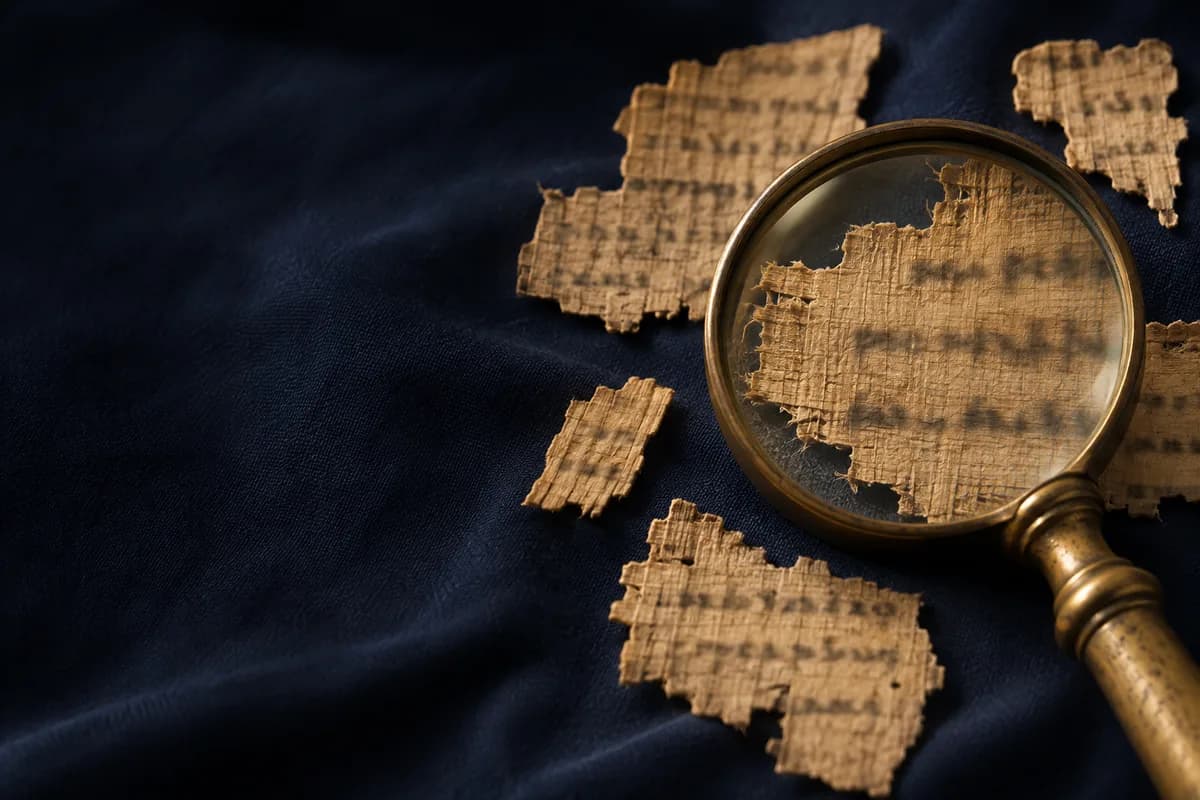 AI-generated imageTextual criticism
How do we know what the New Testament originally said?
No original survives, so scholars compare thousands of copies, early translations, and quotations to work back toward the earliest text. Most differences are minor, and modern Bibles mark the significant ones.Numa Verse Editorial · November 2026 · 6 min read AI-generated imageTextual criticism